
LASIK vs PRK vs SMILE: How it Works, Risks and Recovery
If you are thinking about laser eye surgery to say goodbye to glasses or contacts, you’ve probably heard of LASIK, PRK, and SMILE. But which one is the best fit for your eyes and lifestyle?
These three procedures all correct vision by reshaping the cornea, but they do it in different ways. Their differences can impact your recovery time, comfort, and overall results.
Quick Answer: LASIK vs PRK vs SMILE
All three procedures reshape the cornea to correct vision, but the method changes your recovery and comfort along the way.
LASIK uses a corneal flap and offers the fastest results with minimal discomfort, best for healthy, thick corneas.
PRK skips the flap and treats the eye’s surface directly. Recovery takes longer, but it’s a safer bet for thin corneas or dry eyes.
SMILE removes tissue through a tiny incision, no flap needed. It heals fast and carries the lowest dry eye risk, ideal for active lifestyles.
Bottom line: the right choice depends on your corneas, prescription, and lifestyle. A comprehensive eye exam will confirm what’s best for you.
At InSight Vision Center in Fresno, we want you to feel confident and informed before making a decision that affects your eyesight for years to come.
So, let’s break down what you need to know about LASIK, PRK, and SMILE.
Difference Between LASIK vs PRK vs SMILE: A Quick Glance
| Feature | LASIK | PRK | SMILE |
|---|---|---|---|
| Procedure Type | A flap is created on the cornea, and the laser reshapes the eye underneath. | The surface of the eye is treated directly without making a flap. | A small piece inside the eye is removed through a tiny cut. No flap is needed. |
| Invasiveness | Moderate. A flap is made on the eye’s surface. | More surface-level. The top layer is removed completely. | Minimal. Only a small opening, no flap. |
| Recovery Time | 1–2 days. Vision improves quickly. | 3–7 days. It takes longer and may be uncomfortable. | 1–2 days. Fast recovery, like LASIK. |
| Pain After Surgery | Mild discomfort for a few hours. | Moderate discomfort for a few days. | Mild discomfort, usually short-lasting. |
| Best For | Most people with stable vision and sufficient corneal thickness. | People with thin corneas or dry eyes. | Active people and those prone to dry eyes. |
| Dry Eye Risk | Medium risk of dry eyes after surgery. | Lower than LASIK. | Lowest risk of dry eye among the three. |
| Approved Since (USA) | 1998 | 1996 | 2016 |
| Technology Used | Femtosecond + Excimer lasers. One makes the flap, and the other reshapes. | Excimer laser only. It reshapes the cornea after removing the surface layer. | Femtosecond laser only. Creates and removes corneal tissue via a small cut. |
What Is LASIK Eye Surgery?
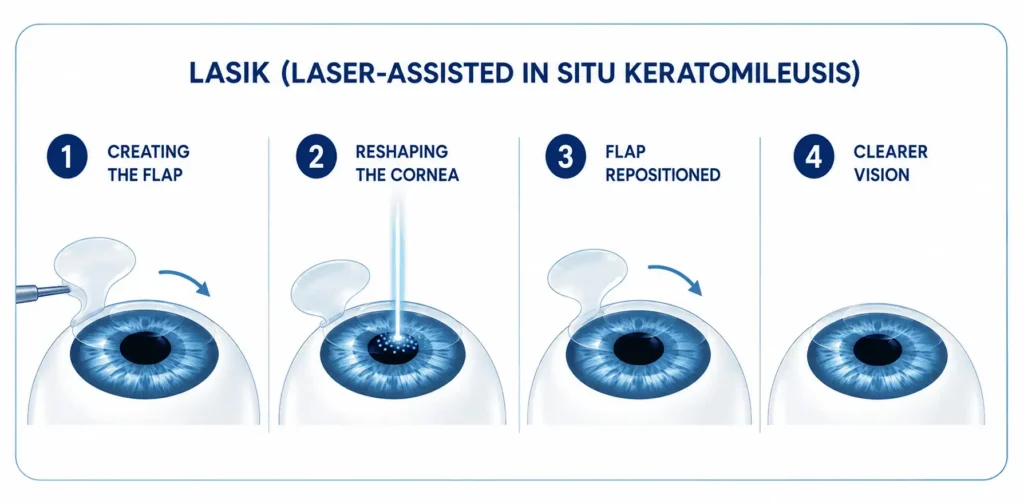
Laser-Assisted In Situ Keratomileusis is referred to as LASIK. The fundamental concept is that a surgeon makes a thin flap on the cornea, which is the transparent front portion of the eye. After this flap is carefully raised, the tissue underneath is reshaped by a laser to treat astigmatism, nearsightedness, and farsightedness.
The flap is reshaped and then repositioned, where it sticks by itself without the need for stitches. It is among the most well-known and widely used laser eye operations.
Learn more about:-LASIK Eye Surgery in Fresno, CA
When LASIK makes sense?
✓Your prescription has held steady for at least a year. ✓Your corneas are thick enough to create a flap safely. ✓You want fast recovery and quick visual improvement. ✓You don’t deal with chronic dry eye.What Are The Benefits of LASIK?
○Quick procedure – About 15 minutes for both eyes. ○
Fast results – Many notice sharper vision within a day. See LASIK recovery time. ○
Minimal discomfort – Numbing drops keep pain low. ○
Strong success rate – Most patients reach 20/25 vision or better.
What are the Risks of LASIK Eye Surgery?
⚠Dry Eyes –Some patients experience temporary or even long-term dryness. ⚠
Glare and Halos –You might notice glare, halos around lights, or double vision, especially at night. ⚠
Flap Complications –Rarely, problems with the corneal flap can occur. ⚠
Infection or inflammation –Although rare, these can happen and require treatment. ⚠
Under or Overcorrection –Sometimes, a second procedure (enhancement) is needed to fine-tune vision.
What Is PRK Surgery?
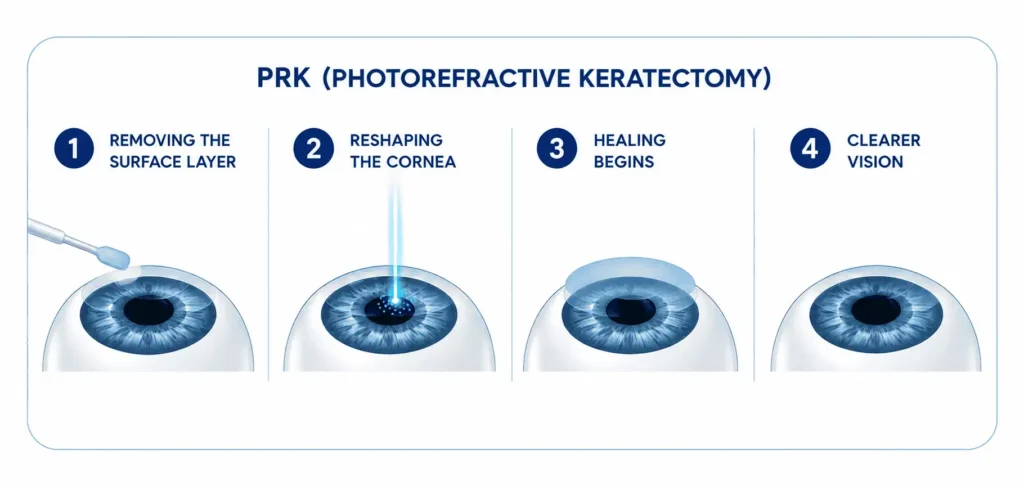
PRK, or Photorefractive Keratectomy, is an effective laser vision correction surgery that predates LASIK. Instead of making a flap, PRK removes the very thin outer layer of your cornea (called the epithelium). Then, an excimer laser reshapes the corneal tissue underneath to correct vision problems. The surface layer naturally grows back over a few days after surgery.
When Do You Choose PRK Surgery?
✓You suffer from or are prone to dry eyes. ✓You work in a profession that increases the risk of eye injury or lead an active lifestyle. ✓You wish to prevent complications from flaps. ✓You have specific surface imperfections or corneal scarring.What Are The Benefits of PRK?
○No Flap – Eliminates flap-related risks ○
Good for Thin Corneas – It can be performed when LASIK isn’t safe. ○
Lower Dry Eye Risk – It often causes fewer dry eye symptoms than LASIK. ○
Suitable for Athletes – No flap means less risk of flap displacement during physical activities.
What are the Risks of PRK Eye Surgery?
⚠Extended Healing Period –It may take a week or longer for visual recovery to occur. ⚠
Discomfort –For a few days, patients may feel mild pain or irritability. ⚠
Temporary Foggy or Fuzzy Vision –Vision may change while mending. ⚠
Risk of Infection –Because the surface layer is removed, the risk of infection is marginally higher than with LASIK. ⚠
Light Sensitivity –Some patients might become sensitive to light during their recovery period.
Learn more about:- LASIK vs. PRK: Key Differences, Benefits, and Process
What Is SMILE Eye Surgery?
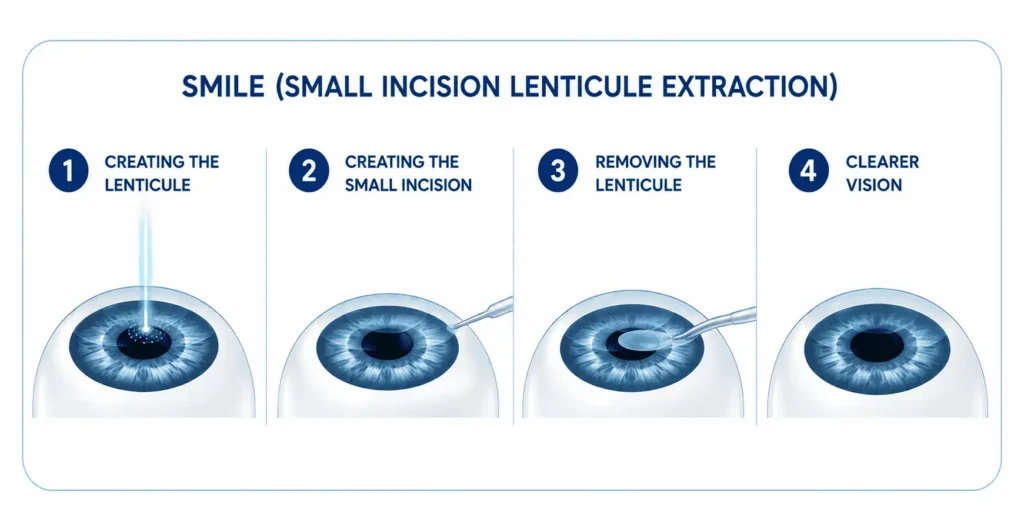
Small Incision Lenticule Extraction is referred to as SMILE. It is a more recent, minimally invasive eye procedure that was authorized in the United States in 2016. A tiny lens-shaped tissue fragment known as a lenticule is created inside your cornea by SMILE using a femtosecond laser.
The surgeon then removes this lenticule through a tiny incision, changing the shape of your cornea to correct your vision. It is less invasive than LASIK since no flap is made.
When Do You Choose SMILE Eye Surgery?
✓You have nearsightedness (myopia) with or without astigmatism. ✓You want a quick recovery with minimal discomfort. ✓You are concerned about dry eye problems. ✓You have an active lifestyle or play contact sports. ✓You want a flapless procedure.What are the Benefits of SMILE Eye Surgery?
○Minimally Invasive – No corneal flap means fewer risks. ○
Less Dry Eye Risk – The small incision preserves corneal nerves. ○
Stable and Predictable Outcomes – High patient satisfaction rates. ○
Fast Recovery – Most patients return to normal activities within a day or two. ○
Reduced Complications – Lower chance of flap-related issues and infections.
What are the Risks of SMILE Eye Surgery?
⚠Limited Treatment Range –Currently, only myopia and astigmatism can be treated ⚠
Visual Recovery –Some patients may notice that vision takes slightly longer to fully stabilize compared to LASIK. ⚠
Not Widely Available –Not all eye centers offer SMILE yet due to specialized equipment. ⚠
Not Suitable for Everyone –Some eye conditions or prescriptions may not qualify for SMILE
Read more about:- SMILE vs LASIK: Which Vision Correction To Choose?
SMILE vs LASIK vs PRK: Cost Comparison
The cost of LASIK, PRK, and SMILE can vary based on your prescription, technology used, and your surgeon’s expertise. While price is important, choosing the procedure that’s safest and most suitable for your eyes should always come first.
| Procedure | Average Cost (Per Eye) | Average Cost (Both Eyes) | Insurance Coverage |
|---|---|---|---|
| LASIK | $2,000–$3,000 | $4,000 – $6,000 | Usually not covered |
| PRK | $2,000–$3,500 | $3,500 – $5,500 | Usually not covered |
| SMILE | $2,500–$4,000 | $4,500 – $7,000 | Usually not covered |
Eyes on the Future: A Podcast on LASIK, SMILE & More with Dr. Poulsen
This informative podcast covers everything from eye diseases and safe corrective eye surgical procedures to candidacy, complication rate, and recovery.
Hear from a trusted ophthalmologist in Fresno – Dr. Eric J Poulsen talk about all the surgical options you have to get rid of bothersome eyeglasses or contacts and learn more about the latest ophthalmology treatments like the smile surgery, corneal crosslinking, monovision LASIK surgery, implantable contact lenses, and the latest developments in cataract surgery.
Know the right treatment for your vision problem, how the surgical procedure is performed, and potential outcomes while also exploring other types of procedures appropriate for your situation, and get the best advice.
Central Valley Physicians · Eye Disease- Eric Poulsen, MDPodcast Link – Eye Disease- Eric Poulsen, MD by Central Valley Physicians
Which Eye Surgery is Best for You?
Ultimately, the most suitable procedure for you depends on your unique eye health and lifestyle. There’s no one-size-fits-all answer. The best way to find out which laser eye surgery fits you best is to schedule a comprehensive eye exam and consultation.
Our experts at InSight Vision Center in Fresno evaluate your eye health, corneal thickness, vision goals, and lifestyle needs to recommend the safest and most effective treatment for your vision correction journey.
Ready for Clear Vision?
Get your LASIK consultation today at InSight Vision Center and take the first step towards a clearer vision.
When it comes to LASIK vs PRK vs SMILE, each procedure has its pros and cons. Your decision should be based on thorough knowledge and expert advice tailored specifically to you.
Whether you want quick recovery, minimal invasiveness, or have special eye conditions, InSight Vision Center is here to guide you every step of the way. Don’t settle for less when it comes to your eyes. Get the care and attention your vision deserves!
Frequentyle Asked Questions About LASIK vs PRK vs SMILE
FAQs – LASIK vs PRK vs SMILE
Is SMILE safer than LASIK?
SMILE isn't necessarily safer, but it's less invasive because it doesn't require a corneal flap. This may reduce certain flap-related risks and preserve more corneal strength.Which procedure is best for thin corneas?
PRK is often recommended for people with thin corneas because it doesn't require creating a flap, preserving more corneal tissue.Can SMILE treat astigmatism?
Yes. SMILE can treat certain cases of astigmatism, although eligibility depends on the severity of your prescription and your eye anatomy.Is LASIK still the most popular laser eye surgery?
Yes. LASIK remains the most commonly performed laser vision correction procedure because of its quick recovery and long history of successful outcomes.Can athletes get LASIK, PRK, or SMILE?
Yes, but PRK and SMILE are often preferred for contact sports athletes because they avoid creating a corneal flap that could potentially be affected by eye trauma.Are LASIK, PRK, and SMILE permanent?
The corneal changes are permanent. However, your eyes can still change naturally with age, and you may eventually need reading glasses or additional vision correction later in life.This article is general information and isn't a substitute for an eye exam.