
RLE vs LASIK vs PRK: Which Surgery Is The Best for You?
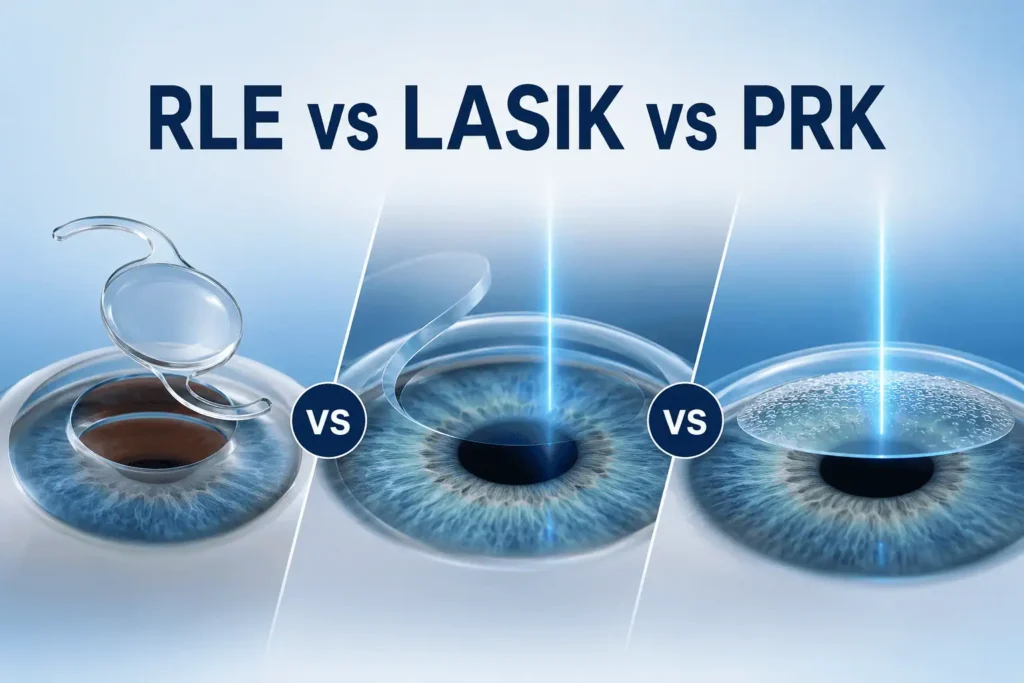
While all three procedures are designed to reduce dependence on glasses and contact lenses, they work differently and are intended for different types of patients.
RLE is often recommended for adults over 40 with presbyopia or early cataract changes, LASIK is best suited for younger adults with healthy corneas, and PRK can be a better option for people with thin corneas or active lifestyles.
Understanding the differences between RLE, LASIK, and PRK can help you choose the procedure that best fits your needs.
RLE vs LASIK vs PRK: Comparison at a Glance
| Key Consideration | RLE | LASIK | PRK |
|---|---|---|---|
| Who Benefits Most? | Adults over 40 dealing with presbyopia, significant farsightedness, or early lens changes | Adults seeking vision correction with healthy corneas and stable prescriptions | Individuals with thin corneas, dry eye concerns, or physically demanding lifestyles |
| Can It Reduce the Need for Reading Glasses? | Often yes | No | No |
| Does It Eliminate Future Cataract Risk? | Yes, because the natural lens is replaced | No, the natural lens remains in place | No, the natural lens remains in place |
| How Long Is Recovery? | Most patients recover within one to two weeks | Vision often improves within one to two days | Healing may take several days to a few weeks |
| What Is Recovery Comfort Like? | Mild irritation or discomfort is possible | Usually associated with minimal discomfort | Recovery discomfort is generally more noticeable |
| Can Patients With Thin Corneas Qualify? | Yes | Often not recommended | Yes |
| Is a Corneal Flap Created? | No | Yes | No |
| Likelihood of Dry Eye Symptoms | Generally low | Moderate risk compared to other options | Lower risk than LASIK |
| Suitable for Active Individuals & Athletes? | Yes | Often suitable, although flap-related concerns may apply | Excellent choice |
| Long-Term Vision Outcomes | Provides durable and stable vision correction | Delivers long-lasting visual improvement | Offers lasting vision correction for eligible patients |
| Typical Age Range | 40+ years | 18 to 40 years | 18 to 40 years |
| Biggest Advantage | Corrects presbyopia and eliminates the possibility of future cataracts | Quick visual recovery with limited downtime | Effective option for patients who are not LASIK candidates due to a thin cornea |
| Primary Drawback | Involves replacing the eye’s natural lens | Not appropriate for every prescription or eye condition | Requires a longer healing period before vision stabilizes |
Everything You Should Know About RLE
What Is RLE & How Does It Work?
Refractive Lens Exchange (RLE) is an advanced vision correction surgery that improves your eyesight by replacing your eye’s natural lens with a customized artificial intraocular lens (IOL).
It is often recommended for adults over 40 who want to reduce their dependence on glasses or contact lenses, especially if LASIK is not the best option.
Although the procedure uses the same surgical technique as cataract surgery, it is performed before cataracts develop.
Who May Benefit Most From RLE?
You may be a good candidate for RLE if you:
- Are over the age of 40.
- Are not an ideal LASIK candidate.
- Have moderate to severe farsightedness (hyperopia).
- Have presbyopia and rely on reading glasses.
- Have corneal abnormalities that limit laser vision correction options.
What Are the Advantages of Choosing RLE?
Some of the most significant benefits of RLE include:
- It can permanently address presbyopia.
- Since the natural lens is replaced, cataracts cannot develop later.
- Vision remains stable for many years.
- Myopia, hyperopia, and astigmatism can often be corrected during the same procedure.
- Multiple IOL options allow for personalized vision goals.
- Most patients do not require future enhancements or touch-up procedures.
What Does the Recovery Look Like After RLE?
Most patients notice improved vision within the first few days after surgery. While complete healing may take several weeks, many individuals return to their normal daily activities relatively quickly under their surgeon’s guidance.
Everything You Should Know About LASIK
What Happens During LASIK Surgery?
LASIK is a laser vision correction procedure that reshapes the cornea to improve how light focuses on the retina. The procedure is performed using advanced laser technology and typically takes only a few minutes per eye.
During LASIK, a thin flap is created in the cornea. The surgeon then reshapes the underlying corneal tissue before repositioning the flap to heal naturally.
Who Is Typically a Good Candidate for LASIK?
You may qualify for LASIK if you:
- Are between 18 and 40 years old, though some older adults may still qualify.
- Have maintained a stable prescription for at least one year.
- Have healthy corneas with adequate thickness.
- Do not have significant dry eye syndrome.
- Have mild to moderate refractive errors.
- Have good overall eye health.
What Are the Benefits of LASIK?
Many patients choose LASIK because:
- Most individuals return to normal activities within three to five days.
- Vision improvement is often noticeable within 24 hours.
- The procedure permanently reshapes the cornea.
- No artificial lens is implanted inside the eye.
- It is popular among athletes and outdoor enthusiasts.
How Fast Is LASIK Recovery?
Recovery after LASIK is generally fast. Most patients experience improved vision within 1 day and can resume many routine activities, like driving and their desk work, within 2-3 days. Although follow-up care remains important.
Everything You Should Know About PRK
How Does PRK Improve Vision?
PRK, or Photorefractive Keratectomy, is a laser vision correction procedure that reshapes the cornea without creating a flap. Instead, the very thin outer layer of the cornea is removed before laser treatment is performed.
Once the cornea heals, light can focus more accurately on the retina, resulting in clearer vision.
Who May Be a Strong Candidate for PRK?
You may be a good candidate for PRK if you:
- Are at least 18 years old.
- Have a stable vision prescription.
- Have thin or irregularly shaped corneas.
- Are not suitable for LASIK due to corneal concerns.
- Have healthy eyes without advanced eye disease.
What Are the Benefits of PRK?
PRK offers several important advantages:
- It can be an excellent option for patients with thin corneas.
- No corneal flap is created, eliminating any flap-related complications.
- It provides long-term correction of nearsightedness, farsightedness, and astigmatism.
- It may be beneficial for certain corneal irregularities.
- Results are typically long-lasting after a single procedure for most patients.
What to Expect During PRK Recovery
PRK recovery usually takes longer than LASIK recovery because the corneal surface must heal properly. Most patients notice gradual vision improvement over several days or weeks, with continued stabilization over time. Many patients also experience blurry vision for the first 3 to 5 days.
RLE vs LASIK vs PRK: How to Choose the Right Vision Correction Procedure
Selecting the best procedure depends on several individual factors. A comprehensive eye examination can help determine which treatment aligns with your needs.
Here are some factors that can affect your choice:
- Your Age: Age often plays a major role in determining candidacy. Younger adults may benefit from LASIK or PRK, while RLE is often recommended for patients over 40 who are experiencing presbyopia.
- Corneal Health & Thickness: Patients with thin corneas may not qualify for LASIK. In these cases, PRK or RLE may be more appropriate alternatives.
- Severity of Vision Problems: The degree and type of refractive error can influence the recommended treatment. Some prescriptions may be better suited for RLE, while others can be effectively treated with LASIK or PRK.
- Recovery Expectations: If rapid recovery is important, LASIK often offers the shortest downtime. Patients considering PRK should be prepared for a longer healing process.
- Long-Term Vision Goals: If preventing future cataracts and addressing presbyopia are priorities, RLE may provide advantages that LASIK and PRK cannot offer.
Considering Vision Correction in Fresno? InSight Vision Center Can Help!
Choosing between RLE, LASIK, and PRK can feel overwhelming without professional guidance.
At InSight Vision Center, our experienced eye doctors perform comprehensive eye examinations to evaluate your vision, corneal health, lifestyle needs, and long-term goals.
Patients throughout Fresno and the surrounding communities trust InSight Vision Center for personalized recommendations and advanced vision correction solutions. Our team takes the time to explain your options so you can make an informed and confident decision.
Not sure whether RLE, LASIK, or PRK is right for you?
Get Guidance at InSight Vision Center in Fresno, CA
This article is general information and isn't a substitute for an eye exam.