Category

Refractive Lens Exchange

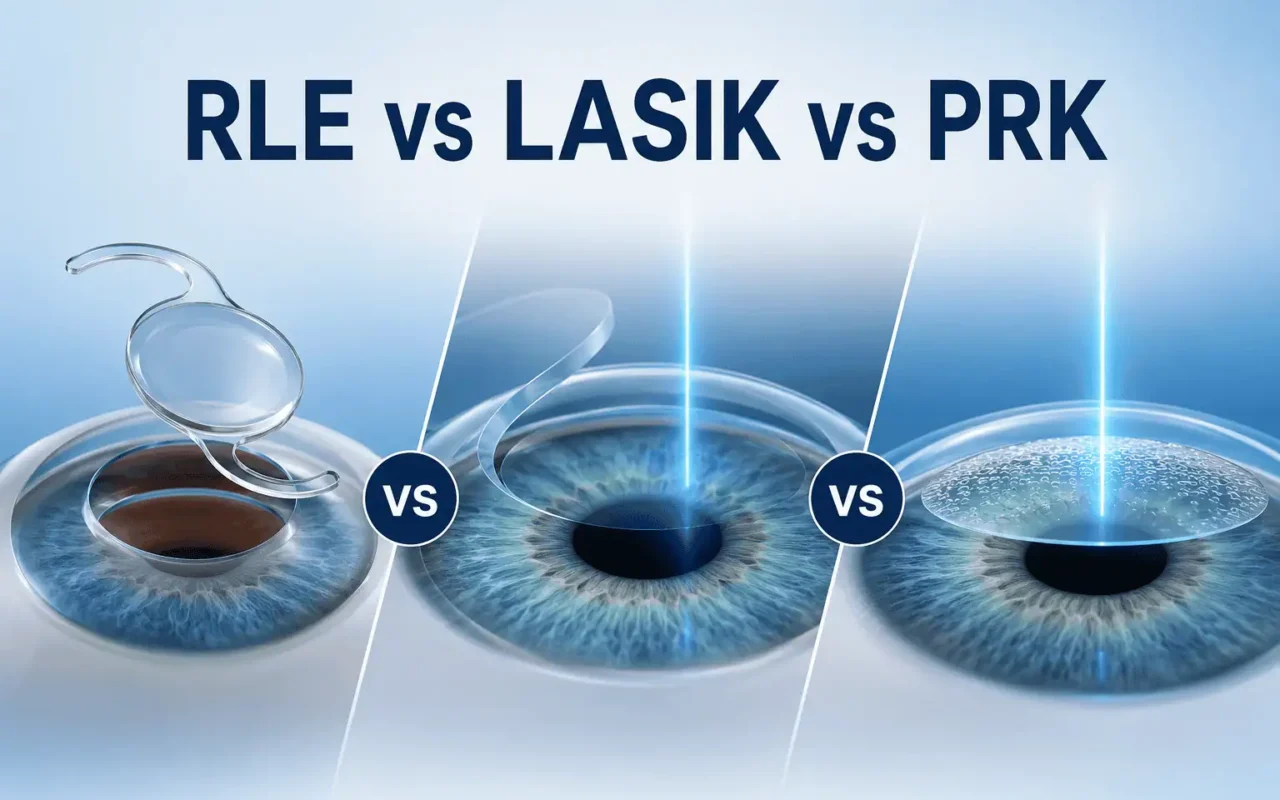
RLE-vs-LASIK-vs-PRK

While all three procedures are designed to reduce dependence on glasses and contact lenses, they work differently and are intended for different types of patients.

RLE is often recommended for adults over 40 with presbyopia or early cataract changes, LASIK is best suited for younger adults with healthy corneas, and PRK can be a better option for people with thin corneas or active lifestyles.

Understanding the differences between RLE, LASIK, and PRK can help you choose the procedure that best fits your needs.

RLE vs LASIK vs PRK: Comparison at a Glance

Key Consideration RLE LASIK PRK
Who Benefits Most? Adults over 40 dealing with presbyopia, significant farsightedness, or early lens changes Adults seeking vision correction with healthy corneas and stable prescriptions Individuals with thin corneas, dry eye concerns, or physically demanding lifestyles
Can It Reduce the Need for Reading Glasses? Often yes No No
Does It Eliminate Future Cataract Risk? Yes, because the natural lens is replaced No, the natural lens remains in place No, the natural lens remains in place
How Long Is Recovery? Most patients recover within one to two weeks Vision often improves within one to two days Healing may take several days to a few weeks
What Is Recovery Comfort Like? Mild irritation or discomfort is possible Usually associated with minimal discomfort Recovery discomfort is generally more noticeable
Can Patients With Thin Corneas Qualify? Yes Often not recommended Yes
Is a Corneal Flap Created? No Yes No
Likelihood of Dry Eye Symptoms Generally low Moderate risk compared to other options Lower risk than LASIK
Suitable for Active Individuals & Athletes? Yes Often suitable, although flap-related concerns may apply Excellent choice
Long-Term Vision Outcomes Provides durable and stable vision correction Delivers long-lasting visual improvement Offers lasting vision correction for eligible patients
Typical Age Range 40+ years 18 to 40 years 18 to 40 years
Biggest Advantage Corrects presbyopia and eliminates the possibility of future cataracts Quick visual recovery with limited downtime Effective option for patients who are not LASIK candidates due to a thin cornea
Primary Drawback Involves replacing the eye’s natural lens Not appropriate for every prescription or eye condition Requires a longer healing period before vision stabilizes

Everything You Should Know About RLE

What Is RLE & How Does It Work?

Refractive Lens Exchange (RLE) is an advanced vision correction surgery that improves your eyesight by replacing your eye’s natural lens with a customized artificial intraocular lens (IOL).

It is often recommended for adults over 40 who want to reduce their dependence on glasses or contact lenses, especially if LASIK is not the best option.

Although the procedure uses the same surgical technique as cataract surgery, it is performed before cataracts develop.

Who May Benefit Most From RLE?

You may be a good candidate for RLE if you:

  • Are over the age of 40.
  • Are not an ideal LASIK candidate.
  • Have moderate to severe farsightedness (hyperopia).
  • Have presbyopia and rely on reading glasses.
  • Have corneal abnormalities that limit laser vision correction options.

What Are the Advantages of Choosing RLE?

Some of the most significant benefits of RLE include:

  • It can permanently address presbyopia.
  • Since the natural lens is replaced, cataracts cannot develop later.
  • Vision remains stable for many years.
  • Myopia, hyperopia, and astigmatism can often be corrected during the same procedure.
  • Multiple IOL options allow for personalized vision goals.
  • Most patients do not require future enhancements or touch-up procedures.

What Does the Recovery Look Like After RLE?

Most patients notice improved vision within the first few days after surgery. While complete healing may take several weeks, many individuals return to their normal daily activities relatively quickly under their surgeon’s guidance.

Everything You Should Know About LASIK

What Happens During LASIK Surgery?

LASIK is a laser vision correction procedure that reshapes the cornea to improve how light focuses on the retina. The procedure is performed using advanced laser technology and typically takes only a few minutes per eye.

During LASIK, a thin flap is created in the cornea. The surgeon then reshapes the underlying corneal tissue before repositioning the flap to heal naturally.

Who Is Typically a Good Candidate for LASIK?

You may qualify for LASIK if you:

  • Are between 18 and 40 years old, though some older adults may still qualify.
  • Have maintained a stable prescription for at least one year.
  • Have healthy corneas with adequate thickness.
  • Do not have significant dry eye syndrome.
  • Have mild to moderate refractive errors.
  • Have good overall eye health.

What Are the Benefits of LASIK?

Many patients choose LASIK because:

  • Most individuals return to normal activities within three to five days.
  • Vision improvement is often noticeable within 24 hours.
  • The procedure permanently reshapes the cornea.
  • No artificial lens is implanted inside the eye.
  • It is popular among athletes and outdoor enthusiasts.

How Fast Is LASIK Recovery?

Recovery after LASIK is generally fast. Most patients experience improved vision within 1 day and can resume many routine activities, like driving and their desk work, within 2-3 days. Although follow-up care remains important.

Everything You Should Know About PRK

How Does PRK Improve Vision?

PRK, or Photorefractive Keratectomy, is a laser vision correction procedure that reshapes the cornea without creating a flap. Instead, the very thin outer layer of the cornea is removed before laser treatment is performed.

Once the cornea heals, light can focus more accurately on the retina, resulting in clearer vision.

Who May Be a Strong Candidate for PRK?

You may be a good candidate for PRK if you:

  • Are at least 18 years old.
  • Have a stable vision prescription.
  • Have thin or irregularly shaped corneas.
  • Are not suitable for LASIK due to corneal concerns.
  • Have healthy eyes without advanced eye disease.

What Are the Benefits of PRK?

PRK offers several important advantages:

  • It can be an excellent option for patients with thin corneas.
  • No corneal flap is created, eliminating any flap-related complications.
  • It provides long-term correction of nearsightedness, farsightedness, and astigmatism.
  • It may be beneficial for certain corneal irregularities.
  • Results are typically long-lasting after a single procedure for most patients.

What to Expect During PRK Recovery

PRK recovery usually takes longer than LASIK recovery because the corneal surface must heal properly. Most patients notice gradual vision improvement over several days or weeks, with continued stabilization over time. Many patients also experience blurry vision for the first 3 to 5 days.

RLE vs LASIK vs PRK: How to Choose the Right Vision Correction Procedure

Selecting the best procedure depends on several individual factors. A comprehensive eye examination can help determine which treatment aligns with your needs.

Here are some factors that can affect your choice:

  • Your Age: Age often plays a major role in determining candidacy. Younger adults may benefit from LASIK or PRK, while RLE is often recommended for patients over 40 who are experiencing presbyopia.
  • Corneal Health & Thickness: Patients with thin corneas may not qualify for LASIK. In these cases, PRK or RLE may be more appropriate alternatives.
  • Severity of Vision Problems: The degree and type of refractive error can influence the recommended treatment. Some prescriptions may be better suited for RLE, while others can be effectively treated with LASIK or PRK.
  • Recovery Expectations: If rapid recovery is important, LASIK often offers the shortest downtime. Patients considering PRK should be prepared for a longer healing process.
  • Long-Term Vision Goals: If preventing future cataracts and addressing presbyopia are priorities, RLE may provide advantages that LASIK and PRK cannot offer.

Considering Vision Correction in Fresno? InSight Vision Center Can Help!

Choosing between RLE, LASIK, and PRK can feel overwhelming without professional guidance.

At InSight Vision Center, our experienced eye doctors perform comprehensive eye examinations to evaluate your vision, corneal health, lifestyle needs, and long-term goals.

Patients throughout Fresno and the surrounding communities trust InSight Vision Center for personalized recommendations and advanced vision correction solutions. Our team takes the time to explain your options so you can make an informed and confident decision.

Not sure whether RLE, LASIK, or PRK is right for you?

Get Guidance at InSight Vision Center in Fresno, CA

Schedule Your Consultation Today

RLE after 40

If you’re over 40 and researching vision correction, you’ve probably noticed something: LASIK isn’t always the first recommendation anymore. More eye surgeons are steering patients in this age group toward refractive lens exchange (RLE) instead, and there’s a clear reason why.

Your eyes change as you age. Presbyopia sets in, cataracts eventually become a factor, and the lens inside your eye starts losing the flexibility it had in your 20s and 30s. LASIK reshapes your cornea, but it doesn’t address any of that. RLE replaces the aging lens itself with an artificial one, which means it can correct your vision now and prevent the need for cataract surgery later.

Continue reading RLE after 40: Why It’s Gaining Popularity Over LASIK?

RLE vs cataract surgery

If you’ve been researching ways to improve your vision, you’ve probably come across both Refractive Lens Exchange (RLE) and cataract surgery. The confusing part is that they sound remarkably similar. Both procedures involve removing the eye’s natural lens and replacing it with an artificial one. Both can improve vision. Both have relatively quick recovery times.

So why are they considered different procedures?

The answer comes down to the reason the surgery is being performed. One is typically chosen to reduce dependence on glasses and address age-related vision changes. The other is performed to remove a cataract that is already affecting vision.

Understanding that distinction can make it much easier to determine which option may be appropriate for your situation.

In this guide, we’ll look at how RLE and cataract surgery compare, who each procedure is designed for, what recovery looks like, and how eye doctors decide which treatment path makes the most sense.

RLE vs Cataract Surgery: A Side-by-Side Comparison

Although the procedures share many similarities, the patient goals are often very different.

Feature Refractive Lens Exchange (RLE) Cataract Surgery
Purpose RLE is primarily a vision correction procedure. It is chosen by people who want to reduce their reliance on glasses or contact lenses, particularly when age-related vision changes make reading, driving, or other daily activities more difficult. Cataract surgery is performed to restore vision that has been reduced by a cataract. The goal is to remove the cloudy lens and help the patient see clearly again.
What Condition Is Being Treated? RLE is commonly recommended for presbyopia, significant farsightedness, and certain cases of nearsightedness where laser procedures may not be the best fit. Cataract surgery specifically treats cataracts, which occur when the eye’s natural lens becomes cloudy and affects vision.
Condition of the Natural Lens During RLE, the natural lens is still clear. It is replaced to improve visual performance and reduce future vision problems. During cataract surgery, the natural lens has already become cloudy and is replaced to restore lost vision.
Who Typically Has the Procedure? Most RLE patients are over 40 and are beginning to notice age-related vision changes, especially difficulty focusing on nearby objects. Cataract surgery is most commonly performed in adults over 60, although cataracts can develop earlier in some people.
Medical Necessity RLE is considered an elective procedure because it is chosen to improve vision rather than treat a medical condition that requires surgery. Cataract surgery is generally considered medically necessary once cataracts begin interfering with daily activities and quality of life.
Main Goal The main objective is greater freedom from glasses and contact lenses at multiple distances. The primary goal is clearer, sharper vision after cataract-related vision loss.
Lens Options Available Patients often select premium lens implants such as multifocal, EDOF, or toric lenses to address multiple vision needs at once. Cataract surgery also offers several lens choices, including monofocal, multifocal, and toric lenses depending on the patient’s goals.
Insurance Coverage Since RLE is considered elective vision correction, insurance plans generally do not cover the procedure. Cataract surgery is often covered by insurance when it is medically necessary, although premium lens upgrades may involve additional costs.
Cost Considerations Patients usually pay the full cost themselves, making the out-of-pocket expense higher. Insurance coverage often reduces the amount patients need to pay directly.
Recovery Experience Recovery is usually straightforward, with many patients noticing improved vision within a few days and continuing improvement over the following weeks. Recovery is similarly quick, with most patients returning to many normal activities shortly after surgery.
Expected Visual Outcome RLE focuses heavily on reducing dependence on corrective eyewear while improving overall vision quality. Cataract surgery focuses on restoring vision that has been lost because of a cloudy lens.
When It Is Usually Recommended Eye doctors may recommend RLE when LASIK is not suitable, when presbyopia becomes frustrating, or when a patient wants a long-term solution for refractive errors. Cataract surgery is recommended when cataracts begin affecting everyday tasks such as reading, driving, watching television, or recognizing faces.

Why These Procedures Are Often Confused?

One reason people mix up RLE and cataract surgery is because the surgery itself looks very similar from a technical standpoint.

In both procedures, the eye’s natural lens is removed and replaced with an artificial intraocular lens, often called an IOL. The surgical techniques, technology, and recovery process can be nearly identical.

What changes is the reason for replacing the lens.

Think of it this way. Cataract surgery removes a lens that has already become cloudy. RLE replaces a lens before that cloudiness develops, mainly to improve how the eye focuses.

The destination may look similar, but the journey starts from a different place.

Understanding Refractive Lens Exchange

What Is RLE?

Refractive Lens Exchange is a lens replacement procedure used to correct vision problems caused by aging or refractive errors. During surgery, the eye’s natural lens is replaced with an artificial lens selected to match the patient’s visual needs. The goal is often to reduce dependence on glasses while providing clearer vision at one or more distances.

Who Usually Considers RLE?

Many RLE patients reach a point where glasses and contact lenses are becoming increasingly frustrating.

Reading glasses may be needed everywhere. Multifocal lenses may not provide the convenience they once did. Some patients discover they are no longer ideal candidates for LASIK because age-related changes inside the eye are becoming more significant than the shape of the cornea.

In those situations, RLE may offer a longer-term solution.

Conditions RLE Can Help Address

RLE is commonly considered for:

  • Age-related near vision loss (presbyopia)
  • Moderate to high farsightedness
  • Certain cases of nearsightedness where laser vision correction may not be ideal
  • Patients seeking greater visual independence

Why Some Patients Choose RLE

One of the biggest advantages of RLE is that it addresses both current and future concerns.

Because the natural lens is removed, cataracts cannot develop later in life. Patients also gain the opportunity to select lens technology that aligns with their lifestyle, whether that means improved distance vision, better near vision, or a broader range of focus.

Recovery After RLE

Most patients notice vision improvements within the first few days. Mild blurriness, dryness, or light sensitivity can occur during the early healing period.

Many people return to work and routine activities within about a week. Vision typically continues to stabilize over several weeks, with full healing occurring over the following month or two.

Understanding Cataract Eye Surgery

What Is Cataract Surgery?

Cataract surgery removes the eye’s cloudy natural lens and replaces it with a clear artificial lens. It is the only proven way to eliminate a cataract and restore vision that has been affected by lens clouding.

Today, cataract surgery is one of the most commonly performed procedures in the world and has helped millions of people regain clearer vision.

How Cataracts Affect Everyday Life

Cataracts often develop gradually.

At first, you may simply notice that your glasses do not seem as effective as they once were. Over time, vision may become increasingly blurry. Colors may appear dull. Night driving can become more difficult because of glare and halos around lights.

Many patients describe it as looking through a foggy window that never quite becomes clear.

When those changes begin interfering with daily activities, cataract surgery is often recommended.

Benefits of Cataract Surgery

Patients commonly report:

  • Sharper and clearer vision
  • Reduced glare around headlights and bright lights
  • Improved color perception
  • Greater confidence during daily activities
  • Reduced dependence on glasses in some situations

Who May Be a Candidate?

Cataract surgery is often recommended when vision changes begin affecting quality of life.

This might include difficulty reading, driving, recognizing faces, working, or enjoying hobbies. If stronger glasses are no longer providing meaningful improvement, it may be time to discuss surgical options with an eye doctor.

Recovery After Cataract Surgery

Recovery is generally smooth and predictable.

Many patients notice visual improvement within the first few days. Reading, watching television, and other light activities can usually be resumed quickly. Most people return to normal routines within a week or two, although complete healing may take several weeks.

Which Procedure Makes More Sense for You?

The answer depends on what is causing your vision problems.

If your main goal is reducing dependence on glasses and you’re dealing with presbyopia or significant refractive errors, RLE may be worth exploring.

If cataracts are already affecting your ability to see clearly, cataract surgery is typically the more appropriate option.

The challenge is that many people fall somewhere in between. Early lens changes, evolving prescriptions, lifestyle needs, and overall eye health can all influence the decision.

That’s why a comprehensive eye evaluation is so important.

Get Guidance From the Team at InSight Vision Center

Choosing between RLE and cataract surgery isn’t always straightforward. Factors such as your age, prescription stability, eye health, visual goals, and the presence of cataracts all play a role in determining the most suitable treatment.

At InSight Vision Center in Fresno, our eye doctors take the time to evaluate the complete picture before making a recommendation. Through a comprehensive eye examination, we can assess your vision, discuss available treatment options, and help you understand which procedure best aligns with your needs and lifestyle.

Ready to explore your options?

Get Consultation at InSight Vision Center in Fresno, CA Schedule an appointment today.

Schedule an appointment today

Frequently Asked Questions

Is refractive lens exchange the same as cataract surgery?

The procedures are very similar from a surgical perspective, but they are performed for different reasons. RLE is typically chosen to improve vision and reduce reliance on glasses, while cataract surgery is performed to remove a cloudy lens that is affecting sight.

Can I get RLE if I already have early-stage cataracts?

Possibly. Some patients who are considering RLE discover early cataract changes during their examination. In these cases, your surgeon will evaluate whether lens replacement should be approached as refractive surgery or cataract surgery based on your eye health and visual goals.

What happens if cataracts are left untreated?

Cataracts generally worsen over time. Vision may become increasingly blurry, colors may appear faded, and tasks such as driving or reading can become more difficult. Left untreated, advanced cataracts can significantly affect quality of life.

Is RLE safe for people with high myopia or hyperopia?

RLE can be an excellent option for some patients with significant refractive errors, particularly when LASIK or other laser procedures may not provide the desired results. An eye examination is needed to determine suitability.

Can cataract surgery provide some of the same benefits as RLE?

Yes. Modern lens implants used during cataract surgery can often correct certain refractive errors as well, helping some patients reduce their dependence on glasses while restoring clearer vision.

Which procedure has a faster recovery?

Recovery timelines are generally similar because both procedures involve replacing the eye’s natural lens. Most patients notice meaningful visual improvement within the first several days.

Can someone who has already had RLE develop cataracts later?

No. Since the natural lens is removed during RLE, cataracts cannot form afterward. This is one reason some patients view RLE as a long-term vision correction solution.

Request your appointment

Request now & we will get back to you as soon as possible.

Call Us 559-449-5050