Last Updated on June 19, 2026 by Aaron Barriga
If you’re considering LASIK surgery, you’ve likely come across a range of medical terms that can feel overwhelming. Understanding this language helps you ask the right questions during your consultation and feel confident about your decision. Below, our fellowship-trained LASIK surgeons at InSight Vision Center in Fresno, CA explain the 20 most important LASIK eye surgery terms in plain, patient-friendly language.
20 LASIK Eye Surgery Terms Explained
1. What is Ablation in LASIK?
Ablation is the precise surgical removal of corneal tissue using an excimer laser. During LASIK, the laser vaporises microscopic layers of tissue to reshape the cornea, correcting how it focuses light onto the retina. The amount of tissue removed depends on your prescription — typically a few microns per diopter of correction.
2. What is Astigmatism?
Astigmatism is a common refractive error caused by an irregularly shaped cornea or lens. Instead of being perfectly round, the eye is shaped more like a rugby ball, which prevents light from focusing evenly on the retina. This causes blurred or distorted vision at all distances. LASIK can correct most types of astigmatism.
3. What is Bilateral LASIK?
Bilateral LASIK means LASIK surgery is performed on both eyes, typically during the same session. Most patients undergo bilateral LASIK for convenience and quicker overall recovery. Your surgeon will assess whether both eyes are suitable candidates before proceeding.
4. What is Bladeless LASIK?
Bladeless LASIK, also called all-laser LASIK or femto-LASIK, uses a femtosecond laser (such as IntraLase) instead of a mechanical microkeratome blade to create the corneal flap. This technique offers greater precision and a more uniform flap thickness, reducing the risk of flap complications. Read more on the differences between blade vs bladeless LASIK surgery.
5. What is the Cornea?
The cornea is the clear, dome-shaped front surface of the eye. It is responsible for approximately 65–75% of the eye’s total focusing power. LASIK reshapes the cornea to correct refractive errors. The cornea has five layers; LASIK works specifically on the middle layer called the stroma.
6. What is a Corneal Flap?
The corneal flap is a thin, hinged section of corneal tissue created at the start of LASIK surgery. The surgeon lifts the flap to access the stroma beneath, applies the laser correction, then repositions the flap — which adheres naturally without stitches. Flap creation is one of the most precise steps of the entire procedure.
7. What is the Corneal Epithelium?
The corneal epithelium is the outermost layer of the cornea — a thin protective sheet of cells that regenerates quickly after injury. In LASIK, the flap is created below the epithelium. In PRK (a surface-based alternative to LASIK), the epithelium is removed entirely and regrows over several days during recovery.
8. What is a Diopter?
A diopter (D) is the unit used to measure the strength of a refractive error. Negative diopter values indicate myopia (nearsightedness); positive values indicate hyperopia (farsightedness). For example, a prescription of -3.00D means moderate myopia. Most LASIK procedures can correct prescriptions within the range of -12.00D to +6.00D, subject to corneal thickness.
9. What is Dry Eye in the context of LASIK?
Dry eye is a condition where the eye does not produce sufficient tears to keep the surface adequately lubricated. It is the most common side effect after LASIK, occurring because the procedure temporarily reduces corneal nerve sensitivity, which affects tear production. Symptoms — burning, grittiness, and fluctuating vision — typically resolve within 3–6 months. Pre-existing dry eye is assessed during your LASIK evaluation and may affect candidacy.
10. What is an Excimer Laser?
An excimer laser is an ultraviolet laser that emits precise pulses of cold light to remove corneal tissue without generating heat. In LASIK, the excimer laser reshapes the stromal layer of the cornea to the exact curvature needed for your prescription. Each pulse removes approximately 0.25 microns of tissue — finer than a human hair.
11. What is Hyperopia?
Hyperopia, or farsightedness, is a refractive error where the cornea is too flat or the eye is too short, causing light to focus behind the retina instead of on it. This makes it difficult to see objects up close. LASIK corrects hyperopia by steepening the central cornea to bring the focal point forward onto the retina.
12. What is an Intraocular Lens (IOL)?
An intraocular lens (IOL) is an artificial lens implanted inside the eye, most commonly to replace the cloudy natural lens removed during cataract surgery. IOLs are not used in standard LASIK, which reshapes the cornea rather than replacing any lens. However, implantable collamer lenses (ICL) are sometimes used as a LASIK alternative for patients who are not suitable candidates.
13. What is a Keratectomy?
Keratectomy refers to the surgical removal or reshaping of corneal tissue. In the context of laser vision correction, photorefractive keratectomy (PRK) is a surface-based procedure where the epithelium is removed and the laser reshapes the cornea directly — without creating a flap. LASIK involves a form of lamellar keratectomy, where a flap is made in the stromal layer.
Note: The surgical removal of a portion of iris tissue is called an iridectomy — a different procedure from LASIK, typically used to treat certain types of glaucoma.
14. What is the Lens?
The natural lens is a clear, flexible structure located just behind the iris and pupil. It works together with the cornea to focus light precisely onto the retina. The lens adjusts its shape to focus at different distances — a process called accommodation. Unlike cataract surgery, LASIK does not affect the natural lens.
15. What is Myopia?
Myopia, or nearsightedness, is the most common refractive error corrected by LASIK. It occurs when the cornea is too steep or the eye is too long, causing light to focus in front of the retina rather than on it. This results in clear near vision but blurry distance vision. LASIK flattens the cornea to shift the focal point back onto the retina.
16. What is the Pupil?
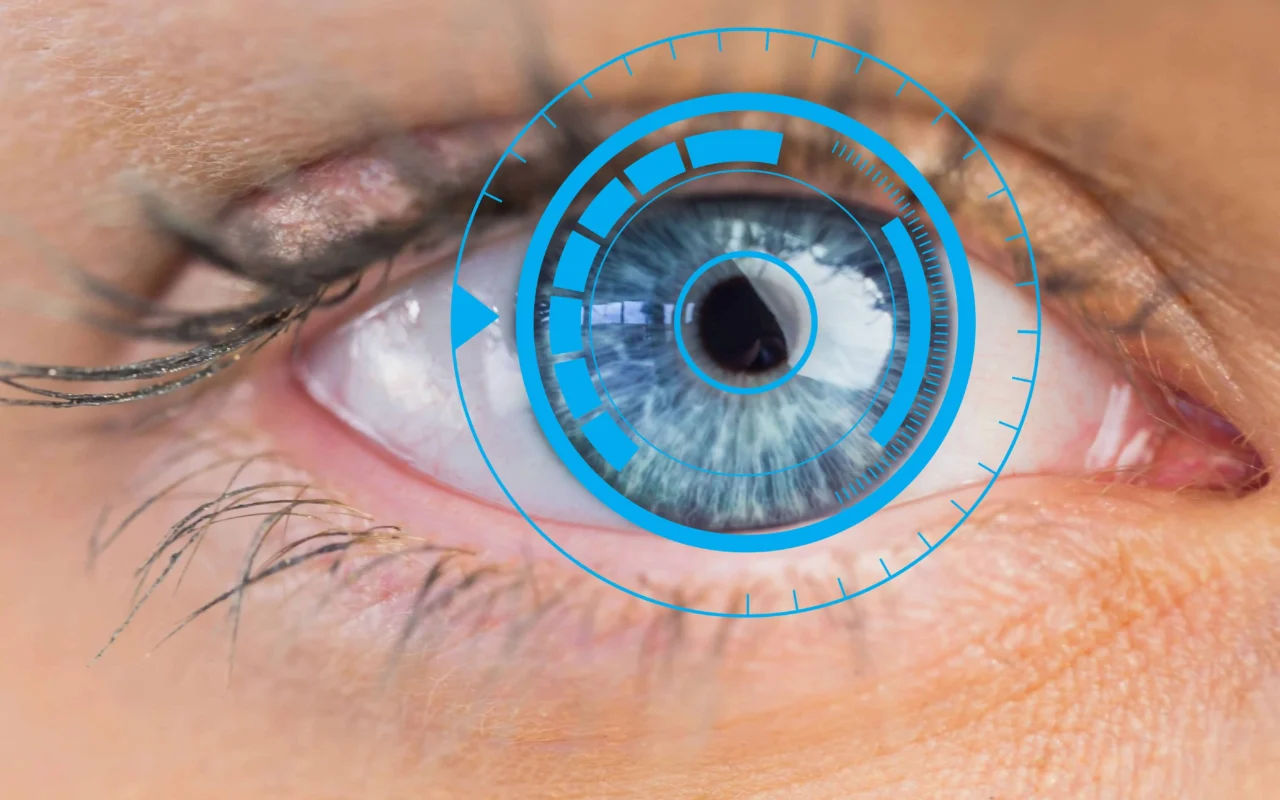
The pupil is the dark, circular opening at the centre of the iris that controls how much light enters the eye. It appears black because light entering the eye is absorbed by the retina. The pupil dilates (expands) in dim light to allow more light in, and constricts (contracts) in bright light. Pupil size is measured during your LASIK consultation — larger pupils may increase the risk of night vision side effects such as halos or starbursts.
17. What is the Retina?
The retina is the light-sensitive layer of tissue lining the inner surface of the eye. It contains millions of photoreceptor cells (rods and cones) that convert light into electrical signals sent to the brain via the optic nerve. LASIK corrects the path of light so that it focuses precisely on the retina, restoring clear vision.
18. What is the Stroma?
The stroma is the thickest middle layer of the cornea, comprising approximately 90% of its total thickness. During LASIK, the excimer laser reshapes the stroma to correct the refractive error. Adequate stromal thickness is critical for LASIK candidacy — surgeons require a minimum residual stromal bed (typically 250–300 microns) after correction to maintain corneal integrity.
19. What is Visual Acuity?
Visual acuity refers to the clarity and sharpness of vision, typically measured using a Snellen chart. It is expressed as a fraction — 20/20 is considered normal vision, meaning you can clearly see at 20 feet what a person with normal vision sees at the same distance. LASIK aims to achieve 20/20 vision or better; many patients reach 20/15 or even 20/10 after surgery.
20. What is Wavefront Technology in LASIK?
Wavefront technology maps the unique optical imperfections of each eye with extreme precision — capturing higher-order aberrations that standard glasses or contact lenses cannot correct. A wavefront-guided LASIK treatment is customised to your eye’s individual map rather than treating only the basic prescription. This can result in sharper vision, better contrast sensitivity, and reduced risk of night vision disturbances compared to conventional LASIK.
Who Is Eligible for LASIK Eye Surgery?
Not everyone is a LASIK candidate. During your consultation at InSight Vision Center, our surgeons evaluate several factors to determine whether LASIK is right for you:
- Age: You should be at least 18 years old, with a stable prescription for at least one to two years.
- Prescription range: LASIK is suitable for myopia up to approximately -12.00D, hyperopia up to +6.00D, and astigmatism up to 6.00D — subject to corneal thickness.
- Corneal thickness: Adequate tissue must remain after the flap is created and correction is applied. Patients with thin corneas may be better suited to PRK or SMILE.
- Overall eye health: Conditions such as keratoconus, severe dry eye, or certain corneal diseases may affect eligibility.
- General health: Autoimmune disorders and certain medications can affect healing and may be contraindications.
Ready to find out if LASIK is right for you?
Book a free consultation at InSight Vision Center in Fresno, CA. Our fellowship-trained surgeons will assess your candidacy and answer every question — no obligations, no pressure.
Free consultation — no obligations
Takes about 1 hour
Fellowship-trained surgeons
12-month interest-free financing

Dr. Azhar I. Salahuddin is an ophthalmologist and is fellowship-trained in cornea, external diseases, and refractive surgery. Dr. Salahuddin has been performing cataract surgery for over 19 years and specializes ocular reconstruction, corneal transplantation surgery as well as vision correction through a variety of intraocular lenses. Dr. Salahuddin is board-certified by the American Board of Ophthalmology and was trained at Boston University.