
Last Updated on June 15, 2026 by Aaron Barriga
Key Takeaways
- Astigmatism after LASIK can occur due to incomplete correction, healing differences, or natural age-related eye changes.
- Most cases are mild and stabilize over time, but persistent symptoms may require evaluation.
- Common signs include blurred vision, glare, halos, eye strain, and headaches.
- Treatment options include LASIK enhancement, lens adjustment, corneal procedures, or glasses and contact lenses.
- Early evaluation helps determine whether changes are part of normal healing or require corrective treatment.
LASIK is highly effective at correcting astigmatism. About 99% of patients achieve 20/40 vision or better, and nearly 90% reach 20/20 or better after surgery. Still, some people notice blur or distortion later and wonder if astigmatism after LASIK is possible. Yes, it is. However, the good news is that in most cases, it’s manageable. Let’s learn more!
What is Astigmatism After LASIK?
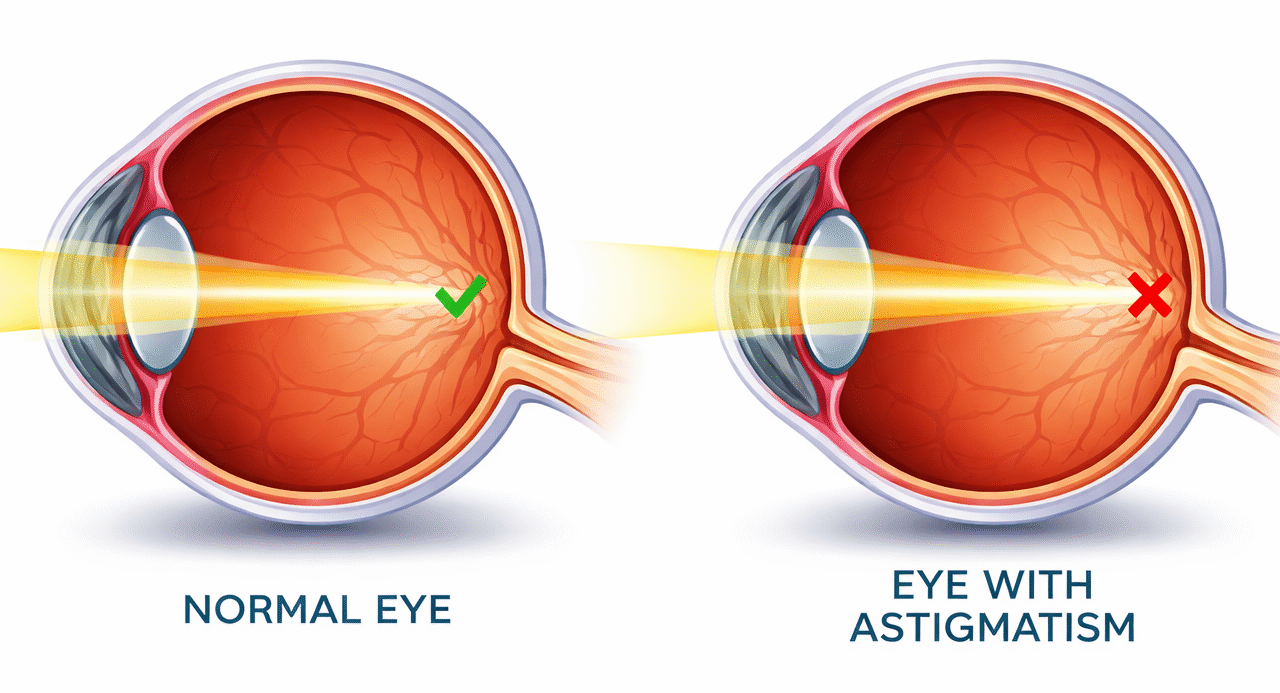
Astigmatism after LASIK refers to uneven corneal curvature that remains or develops after laser vision correction. It is often called residual astigmatism after LASIK, meaning a small amount of irregularity was not fully corrected.
LASIK reshapes the cornea so light focuses properly on the retina. If the reshaping is slightly incomplete, if measurements were imperfect, or if healing changes the corneal surface, mild distortion can remain. In rare cases, age-related concerns, flap healing issues, or long-term corneal changes may cause irregular astigmatism after LASIK.
Most cases are mild. Vision may fluctuate at first, then stabilize. If symptoms persist, further treatment may be considered.
Quick Answer
Yes, astigmatism can return after LASIK, but in most cases it shows up as mild residual astigmatism rather than a reversal of your results. Most cases settle within a few weeks to months as the cornea finishes healing. When treatment is needed, it’s usually a short enhancement procedure, or a switch to glasses or specialty contacts, not a repeat of the original surgery.
Why Does Astigmatism Come Back After LASIK?
While LASIK permanently reshapes the cornea, your eyes can still change over time. Understanding why astigmatism may return helps you know whether it’s a normal shift, a healing variation, or something that needs evaluation. Here are the most common causes of astigmatism post-LASIK.
-
Partial or Incomplete Initial Correction
Sometimes a small degree of astigmatism remains after the first procedure. This residual astigmatism may not be obvious immediately, but it becomes clearer once healing settles.
-
Previously Unnoticed Corneal Irregularities
Before surgery, stronger vision problems can mask minor irregularities. Once corrected, these smaller distortions become noticeable. That is why, sometimes, astigmatism returns after LASIK, even when the procedure was technically successful.
-
Natural Age-Related Eye Changes
Your eyes continue to age after surgery. The cornea and internal lens can shift gradually. Thus, small refractive changes over time are possible.
-
Individual Healing Differences
Every cornea heals differently. Slight differences in tissue response can alter final curvature. This is a common reason for mild astigmatism post-LASIK, especially in the first few months.
-
Other Underlying Eye Conditions
Dry eye, early cataracts, or rare corneal conditions can affect clarity. In uncommon cases, flap-related healing issues may lead to irregular astigmatism after LASIK.
How Common Is Residual Astigmatism After LASIK?
Some degree of residual astigmatism after LASIK is common, though for most patients it’s minor enough that no further treatment is ever needed. Here’s what the research shows:
| What the Research Shows | What It Means for You |
|---|---|
| Retreatment rates for residual over/undercorrection or induced astigmatism after LASIK range from about 5% to 38% across studies, according to the American Academy of Ophthalmology1 | The wide range reflects differences in laser technology, surgical technique, and how much astigmatism was present before surgery |
| In a 20-year analysis of nearly 800 eyes with mixed astigmatism, the overall retreatment rate was about 5.2%, with most enhancements performed within 3 years2 | Astigmatism-specific regression is uncommon, and if it happens, it usually surfaces relatively early |
| The one-year incidence of retreatment after LASIK was found to be 10.5%, with 85% of retreatments occurring within the first year3 | If you’re going to need a touch-up, the first 12 months is when it’s most likely to become apparent |
| Patients with higher amounts of astigmatism before LASIK were found to be roughly four times more likely to need retreatment2 | Higher pre-surgery astigmatism is one of the better predictors of whether a future enhancement might be needed |
| The American Refractive Surgery Council notes that initial LASIK results fall short of the patient’s vision goals in roughly 1% to 5% of cases4 | Most patients who do need an enhancement only need a small adjustment, not a major redo |
Sources: 1. American Academy of Ophthalmology | 2. ESCRS | 3. PubMed / Ophthalmology | 4. American Refractive Surgery Council
Signs and Symptoms of Astigmatism After LASIK Surgery
Symptoms of astigmatism after LASIK surgery vary depending on severity. Common signs include:
-
Eye Fatigue or Frequent Headaches
When the focus is not sharp, the eyes work harder. This may cause fatigue, squinting, or headaches during prolonged screen use or night driving.
-
Glare and Halos, Especially in Low Light
Headlights may appear streaked or surrounded by halos. Low-light conditions make corneal irregularities more noticeable.
-
Blurred or Distorted Vision at Any Distance
Vision may look blurred, shadowed, or slightly doubled. This can affect both reading and distance tasks.
Read More – What does Astigmatism Looks Like?
How is Astigmatism After LASIK Treated?
The treatment for post-LASIK astigmatism depends on the severity of the condition and whether the cornea is stable. Some of the prominent treatment options include:
-
Laser Touch-Up (LASIK or PRK)
If measurements are stable and the cornea is healthy, a LASIK enhancement can fine-tune the original correction. Enhancement procedures are common for treating persistent astigmatism after LASIK surgery.
-
Repositioning or Replacing a Toric Lens
If a toric lens is used in lens-based surgery, slight rotation can cause blur. Repositioning or replacing it can restore clearer vision.
-
Piggyback Intraocular Lenses
In some cases, a secondary intraocular lens is placed to correct leftover refractive error without reshaping the cornea again.
-
Corneal Relaxing Incisions
These small surgical adjustments reshape specific corneal areas contributing to astigmatism.
-
Glasses or Contact Lenses
Mild residual astigmatism after LASIK can often be corrected with glasses or specialty contact lenses, particularly for night driving.
Expert Evaluation at InSight Vision Center in Fresno and Madera, CA
At InSight Vision Center in Fresno, CA, our experienced eye doctors serving Fresno and Madera perform LASIK surgery using advanced diagnostic technology to ensure precise, personalized outcomes for patients across the Central Valley. As a trusted eye clinic in Fresno and Madera, we carefully evaluate corneal healing, visual stability, and overall eye health if you experience symptoms of astigmatism after LASIK.
Our team will clearly explain whether your symptoms are part of normal recovery, age-related changes, or true refractive regression. Early evaluation at our Fresno and Madera eye clinic locations allows us to recommend the most appropriate next step, whether that is continued monitoring, a LASIK enhancement, or another corrective treatment tailored to your vision needs.
Get Expert Evaluation for Astigmatism after LASIK at InSight Vision Center in Fresno and Madera, CA
LASIK has an excellent success rate! Most patients enjoy long-term clear vision! However, astigmatism post-LASIK can occur due to healing patterns, incomplete correction, or natural eye changes. The good news is that most cases are mild and treatable. If your vision feels different after surgery, a detailed eye exam can identify the cause and guide the next step.
Frequently Asked Questions

Dr. Azhar I. Salahuddin is an ophthalmologist and is fellowship-trained in cornea, external diseases, and refractive surgery. Dr. Salahuddin has been performing cataract surgery for over 19 years and specializes ocular reconstruction, corneal transplantation surgery as well as vision correction through a variety of intraocular lenses. Dr. Salahuddin is board-certified by the American Board of Ophthalmology and was trained at Boston University.