
LASEK vs PRK vs LASIK: What Is The Difference
In 2026, LASIK still leads the way, making up around 80 to 85% of all laser eye surgeries in the US. But non-cutting alternatives like PRK and LASEK are quickly gaining ground. According to Moskowitz Eye, these gentler options could make up 40% of all new vision correction surgeries by 2030. If you’re considering laser eye surgery, it can be tough to figure out which route to take. LASIK, PRK, and LASEK each have their own advantages, recovery timelines, and suitability depending on your eye health and lifestyle. Many people feel unsure about what’s right for them. In this blog, we’ll break down all three procedures in a clear, side-by-side comparison to help you make the right choice with confidence.
Understanding the Core Differences Between LASEK, PRK, and LASIK
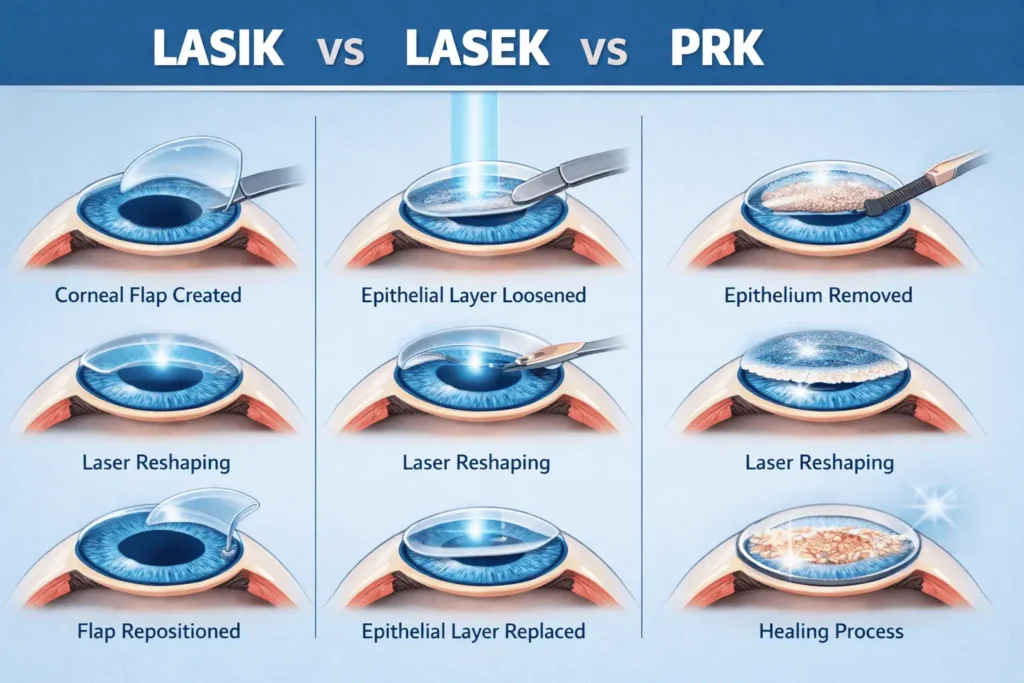
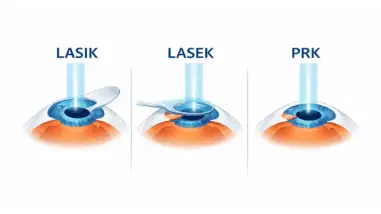
When it comes to laser eye surgery, the three most commonly discussed procedures are LASIK, LASEK, and PRK. Each one aims to correct vision by reshaping the cornea, but they go about it in slightly different ways. If you’re thinking about vision correction, it’s helpful to understand what makes each one unique so you can have an informed conversation with your eye doctor.
-
LASIK: The Flap-Based Procedure
LASIK is probably the most well-known option. It works by creating a thin flap in the cornea using a laser or a blade. This flap is gently lifted, and then another laser reshapes the underlying corneal tissue. Once done, the flap is placed back like a natural bandage. Most people choose LASIK because recovery is fast and discomfort is minimal. Vision improves quickly, often within a day or two. However, because the flap stays on the eye permanently, it may not be ideal for people who play contact sports or are at risk of eye injuries.
-
LASEK: The Surface Procedure with Epithelial Preservation
LASEK takes a different approach. Instead of creating a full corneal flap, it loosens and lifts just the top layer of cells called the epithelium. After that, the laser reshapes the cornea, and the epithelial layer is gently repositioned back in place. This method keeps the deeper corneal structure more stable, which is helpful for people with thinner corneas. Recovery takes a bit longer than LASIK and might involve some temporary discomfort. Still, LASEK offers good long-term results and is often chosen when LASIK is not recommended due to corneal thickness or shape.
-
PRK: The Original Surface Ablation Technique
PRK is one of the oldest types of laser vision correction and is still widely used today. In this method, the outer layer of the cornea is removed entirely before the laser reshapes the tissue underneath. The eye then grows back the epithelium naturally over a few days. PRK is a good option for people with thin corneas or certain eye health concerns. Since there is no flap involved, it reduces some of the long-term risks associated with LASIK. The main trade-off is that recovery takes longer and there may be more discomfort in the early days after surgery.
| Feature | LASIK | LASEK | PRK |
|---|---|---|---|
| Corneal Treatment Method | A thin flap is created on the cornea, and the laser reshapes the underlying tissue. The flap is then placed back. | The outer epithelial layer is loosened using an alcohol solution and gently moved aside before laser correction. | The epithelial layer is completely removed so the laser can directly reshape the cornea. |
| Flap Creation | Yes, a permanent corneal flap is created. | No permanent flap. Only the epithelial layer is lifted temporarily. | No flap at all. The surface layer is removed and grows back naturally. |
| Recovery Time | Vision improves quickly, usually within 24 to 48 hours. | Recovery takes longer, typically around 4 to 7 days. | Similar to LASEK but may take slightly longer, around 5 to 7 days for initial healing. |
| Post-Operative Discomfort | Minimal discomfort. Most patients feel only mild irritation for a short time. | Moderate discomfort during the first few days as the surface heals. | Highest discomfort among the three, especially in the first few days after surgery. |
| Best Suited For | People with healthy eyes and sufficient corneal thickness. Ideal for those seeking fast recovery. | People with thin corneas or those involved in contact sports where flap risk is a concern. | People with very thin corneas or those involved in high-impact activities such as military training or athletics. |
| Risk Related to Flap | Small risk since a flap is involved, especially with eye trauma. | Lower risk compared to LASIK since no permanent flap exists. | No flap-related risk at all. |
| Long-Term Vision Stability | Most stable results. About 3.6% of patients show a vision change greater than 0.50 diopters after 6 months. | Slightly less stable than LASIK. Around 7.7% show a change greater than 0.50 diopters at 6 months. | Lowest stability among the three. About 22.8% show a change greater than 0.50 diopters at 6 months. |
| Visual Accuracy at 6 Months | 100% of patients achieve vision within ±1.00 diopter of the target correction. | Around 98% reach vision within ±1.00 diopter. | About 99% reach vision within ±1.00 diopter. |
| Return to Daily Activities | Most people return to normal activities within a day or two. | Takes a few more days due to surface healing. | May take up to a week or more for comfortable daily activity. |
Related Read – LASIK vs LASEK: Clear Vision Choice Explained for Your Eyes
Which Procedure Is Right for Your Eyes?
Here are a few important things to consider before finalizing a procedure:
-
Corneal Thickness Requirements
Corneal thickness plays a major role in determining which procedure you qualify for. LASIK usually requires a thicker cornea because it involves creating a flap. If your cornea is on the thinner side, your doctor might suggest LASEK or PRK instead. These surface-based techniques preserve more of your cornea and are considered safer in such cases. If you’re not sure about your corneal thickness, a simple scan during your consultation will answer.
-
Lifestyle and Occupation Considerations
Your daily routine and job can influence the type of surgery that suits you best. If you play contact sports, work in high-risk environments, or have hobbies where your eyes could get bumped or rubbed often, LASIK might not be the safest choice because of the permanent flap. In those cases, PRK or LASEK could be better options since they don’t involve a flap, lowering the risk of complications from trauma. If you have a less physically demanding lifestyle and want fast recovery, LASIK could still be a good fit.
-
Pre-Existing Eye Conditions That Affect Eligibility
Certain eye conditions can make one procedure safer than another. If you have chronic dry eyes, LASIK may worsen the issue, while PRK or LASEK tends to cause less dryness in the long run. If you’ve had previous eye surgeries, irregular corneal shapes, or conditions like keratoconus, your eye doctor will likely steer you away from LASIK. They may recommend PRK or advise against laser surgery altogether, depending on your individual case. That’s why a full eye exam is always the first step before moving forward.
| Candidate Factor | LASIK | LASEK | PRK |
|---|---|---|---|
| Minimum Corneal Thickness | Requires a corneal thickness of about 500 microns or more, since a flap is created during the procedure. | It can be considered if the corneal thickness is around 480 microns or higher. | Suitable even for thinner corneas, starting at around 450 microns, as no flap is created. |
| Dry Eye Syndrome | Usually not recommended for people with existing dry eye issues, as symptoms may worsen. | It can be done with proper pre and post-procedure care to manage dryness. | Often preferred for patients with dry eyes since it causes less disruption to corneal nerves. |
| Athletes or High-Impact Activities | There is a small risk of flap-related issues if the eye is hit or rubbed strongly. | A safer option compared to LASIK for people involved in contact sports. | Considered the safest choice for athletes and defense personnel due to the absence of a flap. |
| Large Pupils | May lead to glare or halos in low light conditions for some patients. | Usually handles larger pupil sizes better than LASIK. | Also, a suitable option for larger pupils, with fewer night vision complaints. |
| Corneal Irregularities | Generally not advised if the cornea has surface irregularities. | It may be considered in mild cases after evaluation. | Often preferred when the corneal surface is uneven or irregular. |
| Recurrent Corneal Erosion | Not suitable, as creating a flap can increase future risks. | A safer alternative when this condition is present. | Often recommended as it removes the problematic surface layer entirely. |
Also Read – LASIK vs PRK vs SMILE: How it Works, Risks and Recovery
Recovery Process and Timeline Comparison
Each laser eye procedure comes with its own healing timeline. While all three aim to improve your vision, the way your eyes feel and recover after surgery can vary quite a bit. Here’s what you can expect during each stage of recovery for LASIK, LASEK, and PRK.
First 24–72 Hours: Immediate Post-Op Experience
LASIK: Most people notice clearer vision within the first day. There might be mild irritation, dryness, or light sensitivity, but it’s usually manageable. Many are back to work or regular activities within 24 to 48 hours.
LASEK: Recovery starts slower than LASIK. You may feel eye discomfort, watering, or a gritty sensation. Since the outer layer of cells is repositioned and healing, vision can be blurry for the first few days. A bandage contact lens is often used to protect the eye.
PRK: This is usually the most uncomfortable early on. Because the outer layer is removed entirely, you may feel burning, tearing, or sensitivity to light. Vision remains blurry for several days, and a bandage lens is also applied to aid healing.
First Week: Critical Healing Period
LASIK: By the end of the first week, most discomfort is gone. Vision continues to sharpen, and you can resume many normal activities. It’s still important to avoid rubbing your eyes or doing anything too physically intense.
LASEK: Vision slowly improves, and discomfort lessens after the first few days. The epithelial layer continues healing under the protective lens, which is usually removed after about 4–5 days. You’ll need to be extra careful during this period.
PRK: Healing remains slow through the first week. Vision improves gradually, and the bandage lens is usually removed by day 5 or 6. You might still have light sensitivity or haze, but these will begin to ease.
Long-Term Visual Stabilization (1–6 Months)
LASIK: Most people achieve stable vision within a few weeks. Minor changes may continue for a month or two, but the majority of healing is quick. Long-term outcomes are usually very consistent and clear.
LASEK: It can take several weeks for vision to stabilize completely. While most people notice clear vision after a few weeks, some may take up to 2 months for full sharpness. The results are usually similar to LASIK once fully healed.
PRK: PRK takes the longest to reach final visual clarity. While daily functioning returns after a couple of weeks, the clearest vision can take 3 to 6 months. It requires more patience, but the long-term results are just as strong as LASIK and LASEK.
| Recovery Phase | LASIK | LASEK | PRK |
|---|---|---|---|
| First 24 Hours | Mild discomfort. Eyes may feel watery or slightly irritated. Vision is often usable within hours. | Moderate discomfort with noticeable light sensitivity. Vision is hazy. | Significant discomfort with strong light sensitivity. Vision is very blurry. |
| Day 2 to 3 | Most people can return to normal daily activities. Vision improves quickly. | Vision starts improving but discomfort and dryness may continue. | Vision remains blurry and discomfort is still present. Rest is usually required. |
| Day 4 to 7 | Vision stabilizes further with very few restrictions. | Vision continues to improve and most regular activities can be resumed. | Vision begins to clear, but activity restrictions remain important. |
| One Week | Around 90% of vision recovery achieved. | Around 70% of vision recovery achieved. | Around 50% of vision recovery achieved. |
| One Month | Vision is almost fully clear and stable. | Vision is nearly stable with minor fluctuations. | Noticeable improvement, but vision may still fluctuate. |
| Three to Six Months | Vision fully stabilizes. | Vision fully stabilizes. | Vision fully stabilizes. |
| Return to Work | Usually within 1 to 2 days. | Usually within 3 to 5 days. | Usually within 5 to 7 days. |
| Return to Sports | Light sports after 1 week. | Sports usually allowed after 2 to 4 weeks. | Sports usually allowed after 4 to 6 weeks. |
Also Read – LASIK vs. PRK: Key Differences, Benefits, and Process
Cost Comparison and Financial Considerations
| Cost Factor | LASIK | LASEK | PRK |
|---|---|---|---|
| Average Cost Per Eye (US) | Around 2,250 to 2,500 dollars per eye | Around 2,250 to 2,500 dollars per eye | Around 2,250 to 2,500 dollars per eye |
| Estimated Total Cost for Both Eyes | Roughly 2,500 to 6,500 dollars, depending on the clinic and technology | Roughly 1,750 to 6,000 dollars, depending on the clinic and technology | Roughly 1,750 to 6,000 dollars, depending on the clinic and technology |
| Technology Add-On Costs | Advanced options like wavefront-guided LASIK may add 300 to 800 dollars | Technology upgrades usually add around 200 to 600 dollars | Similar technology upgrades usually add around 200 to 600 dollars |
| Financing and Payment Plans | Widely available. Many clinics offer monthly plans with zero interest for a fixed period | Commonly available through clinics or third-party providers | Commonly available through clinics or third-party providers |
| Recovery-Related Cost Impact | Minimal downtime, which may reduce time off work and related expenses | Moderate downtime may lead to a few additional days off work | Longer recovery may increase indirect costs like time off work |
| Overall Long-Term Value | High, mainly due to faster recovery and quicker return to routine life | Moderate, as recovery takes longer but results are similar | Moderate, with excellent visual outcomes but slower recovery |
Closing Thoughts
LASIK, LASEK, and PRK can all deliver clear and lasting vision, but the right choice depends on your eyes and your lifestyle. Some options heal faster, while others are safer for thinner corneas or active routines. That’s why there’s no single best procedure for everyone. A detailed eye exam and an honest discussion with your eye doctor at InSight Vision Center will help you choose the option that feels right and gives you confidence moving forward.
Get Clear Guidance for Your Laser Eye Surgery at InSight Vision Center
Frequently Asked Questions About LASEK vs PRK vs LASIK
Is LASEK more like LASIK or PRK?
LASEK actually sits somewhere between LASIK and PRK. It’s closer to PRK in how the procedure is done since it doesn’t involve cutting a flap in the cornea like LASIK. But it also borrows from LASIK in terms of comfort and healing. If you want a clearer breakdown of how LASIK and PRK compare, you can check out this LASIK vs PRK guide.Why does the military prefer PRK over LASIK?
The military often chooses PRK for its personnel because there’s no corneal flap created during the procedure. That means there’s less risk of eye injury in combat or during physical activity. PRK might have a longer recovery, but it’s considered more stable for people in high-impact or physically demanding jobs.Can you get LASIK after PRK?
It’s possible, but not very common. In some cases, if your vision changes years after PRK and your cornea is thick enough, a surgeon might consider LASIK for enhancement. Most people who’ve had PRK don’t usually need LASIK later, but it depends on your eye health and how your vision changes over time.Which procedure has the fastest recovery time?
If you’re looking for a quick recovery, LASIK is usually the fastest. Most people can see clearly and return to normal activities within a day or two. PRK and LASEK take a bit longer because the surface layer of the cornea needs time to heal. It might take several days to a week before your vision stabilises with those procedures.What is the success rate of LASIK compared to PRK?
Both LASIK and PRK have very high success rates. Studies show that over 95 percent of patients in both groups reach 20/40 vision or better, which is good enough to pass a driving test without glasses. The long-term results are also quite similar. The main difference is how fast you heal and how the procedure is done.How much does LASEK cost compared to LASIK?
LASEK tends to cost about the same as LASIK in most clinics. In some cases, it might be slightly less expensive, but not by a huge margin. The final cost often depends on the technology used, the surgeon’s experience, and where you’re getting the procedure done. Always ask for a full breakdown of what’s included in the quoted price.This article is general information and isn't a substitute for an eye exam.