
Nearsighted vs Farsighted vs Astigmatism: Know the Difference
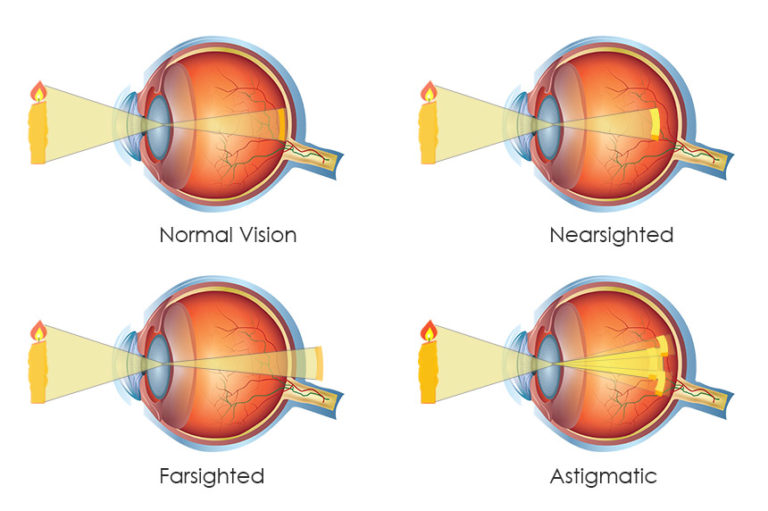
Nearsightedness (myopia), farsightedness (hyperopia), and astigmatism are common, treatable refractive errors where the eye cannot focus light properly. Myopia causes blurry distance vision, hyperopia makes near objects harder to see, and astigmatism leads to overall distorted vision. These conditions are often inherited and can be corrected with glasses, contact lenses, or LASIK.
Nearsighted vs Farsighted vs Astigmatism
| Feature | Nearsighted (Myopia) | Farsighted (Hyperopia) | Astigmatism |
|---|---|---|---|
| Vision Problem | Distant objects are blurry | Near objects are blurry | Blurry at all distances |
| Eye Shape | Eyeball too long or cornea too curved | Eyeball too short or cornea too flat | Cornea/lens is irregularly shaped |
| Common symptoms | Squinting, headaches | Eye strain, reading difficulty | Distorted vision, halos around lights |
| Corrective Lenses | Concave (minus) lenses | Convex (plus) lenses | Cylindrical lenses |
| Can It Worsen? | Yes, especially in childhood | Often improves with age | Can change gradually over time |
📊 Key Statistic:
As of 2025:
- Approximately 41.6% to 42% of Americans are myopic
- Hyperopia impacts roughly 10% of Americans.
- Over 70% of school-age children (aged 5–17) have some degree of astigmatism.
- Among certain populations, the overall prevalence of astigmatism (CYL ≥ 0.5 D) was found to be 73.81%, increasing significantly with age.
What is Myopia?
Myopia or Near-Sightedness occurs when light cannot focus on the retina, causing faraway objects to appear unclear or blurry. It happens when the eyeball is too long or when you have a cornea that is curved too much. Myopia often begins before you enter your teenage years. Heredity and environmental factors can also be the cause of short-sightedness.
Symptoms of Myopia
- Blurred Distance Vision: Difficulty seeing far-away objects clearly, such as road signs, televisions, or whiteboards.
- Squinting: Frequently narrowing the eyelids to temporarily improve the focus of distant objects.
- Eye Strain and Fatigue: Eyes feel tired or sore from trying to focus.
- Headaches: Resulting from constant straining to see clearly.
- Poor Night Vision: Difficulty seeing clearly while driving at night.
- Reduced Depth Perception: Difficulty judging how far away objects are.
Read our complete guide: Astigmatism VS Myopia (Nearsightedness): What is the Difference?
What is Hyperopia?
Hyperopia, or farsightedness, is a common refractive error where distant objects are seen more clearly than nearby ones. It occurs when light entering the eye focuses behind the retina instead of directly on it. This can make close-up tasks like reading or using a phone difficult and may lead to eye strain or headaches.
Symptoms of Hyperopia
- Blurry Near Vision: Close-up objects appear out of focus, while distant vision is usually clearer.
- Eyestrain: A persistent feeling of tiredness, aching, or burning in and around the eyes.
- Headaches: Common after prolonged near work, like reading, writing, or screen use.
- Squinting: Frequently squinting to improve focus and clarity.
- Fatigue/Irritability: General discomfort or tiredness after tasks that require close focus.
- Difficulty Reading: Trouble maintaining focus on text or needing to hold it farther away to see clearly.
- Symptoms in Children: May include slow reading, learning challenges, or eye crossing (strabismus).
Read our complete guide: Nearsightedness vs. Farsightedness: Causes, Symptoms & Prevention
What is Astigmatism?
Astigmatism is an eye condition where the cornea is irregularly shaped, and objects cannot focus properly on the retina, causing two focal points. This not only causes blurred vision but also distorts it. People suffering from astigmatism experience eye-strain, headaches, or blurred vision at a certain distance. It can be genetic, but environmental factors can also contribute to the problem.
Symptoms of Astigmatism
- Blurred or Distorted Vision: Vision may appear blurry in specific directions or overall, with images looking stretched or uneven.
- Eye Strain and Fatigue: Ongoing effort to focus can make the eyes feel tired and uncomfortable.
- Headaches: Frequent headaches can result from constant focusing strain.
- Squinting: Regularly squinting to improve clarity is a common symptom.
- Difficulty with Night Vision: Halos, glare, or starburst patterns around lights are often more noticeable at night.
Astigmatism rarely occurs on its own. Many people who have myopia or hyperopia also have some degree of astigmatism at the same time. This is why getting a comprehensive eye exam is so important, as only a full refraction test can reveal the exact combination of conditions affecting your vision and ensure your prescription addresses all of them accurately.
How Are These Conditions Diagnosed?
Many people live with blurry or distorted vision for years without realizing they have a correctable refractive error. The only way to know for certain whether you have myopia, hyperopia, or astigmatism, and how severe it is, is through a comprehensive eye exam performed by a qualified eye care professional.
Unlike a basic vision screening at school or your workplace, a comprehensive eye exam goes much deeper. It evaluates not just how well you can read a chart, but how your eyes focus light, how your cornea is shaped, and whether any underlying conditions are developing. Here’s what you can typically expect:
- Visual Acuity Test: Measures how clearly you can see at near and far distances using an eye chart.
- Refraction Test: Determines your exact prescription by finding which lenses provide the clearest vision.
- Keratometry and Corneal Topography: Measure the shape and curvature of the cornea to detect astigmatism and assess eye health.
- Slit-Lamp Examination: Uses magnification to examine eye structures and rule out other causes of vision problems.
When should you schedule an eye exam?
You don’t need to wait until your vision gets noticeably worse. We recommend scheduling an exam if you experience any of the following:
- Frequent headaches or eye strain, especially after reading or screen time
- Difficulty reading road signs or seeing clearly at a distance
- Blurred or distorted vision at any distance
- Squinting to bring objects into focus
- Difficulty seeing clearly at night or around lights
What are the Treatment Options for These Refractive Errors?
The good news is that all three refractive errors, myopia, hyperopia, and astigmatism, are highly treatable. Depending on the severity of your condition, your age, your lifestyle, and your personal preferences, your eye doctor will recommend one or more of the following treatment options.
1. Eyeglasses
Eyeglasses are the most common, simplest, and safest way to correct refractive errors. They work by adjusting the way light enters the eye so it focuses correctly on the retina, giving you clear and comfortable vision.
- For myopia, concave lenses (marked with a minus sign) are used to diverge light before it enters the eye.
- For hyperopia, convex lenses (marked with a plus sign) converge light so it reaches the retina properly.
- For astigmatism, cylindrical lenses correct the uneven curvature of the cornea or lens.
Eyeglasses come in a wide range of styles, including single vision, bifocal, and progressive lenses, making them suitable for people of all ages. They are also the recommended first line of treatment for children.
2. Contact Lenses
Contact lenses offer the same vision correction as eyeglasses but sit directly on the surface of the eye. They provide a wider, more natural field of vision and are a popular choice for people with active lifestyles.
- Soft contact lenses are available for myopia and hyperopia.
- Toric contact lenses are specially designed to correct astigmatism by accounting for the irregular shape of the cornea.
- Daily disposable, bi-weekly, and monthly lenses are available depending on your preference and eye care needs.
Your eye doctor will perform a contact lens fitting to ensure the lenses sit correctly on your eye and that your cornea receives enough oxygen throughout the day.
Read our complete guide: What Is a Contact Lens Exam? Everything You Need to Know
3. LASIK Eye Surgery
LASIK (Laser-Assisted In Situ Keratomileusis) is one of the most popular and well-established surgical options for correcting refractive errors in adults. The procedure uses a laser to precisely reshape the cornea so that light focuses correctly on the retina, reducing or eliminating the need for glasses or contact lenses.
- For myopia, the cornea is gently flattened to reduce its curvature.
- For hyperopia, the cornea is steepened to improve its focusing power.
- For astigmatism, the uneven curves of the cornea are smoothed out.
LASIK is a quick procedure, typically completed in under 15 minutes for both eyes, with most patients experiencing significantly improved vision within 24 hours. However, not everyone is a suitable candidate. People with thin corneas, very high prescriptions, or certain eye conditions may not qualify. A thorough pre-surgical evaluation at InSight Vision Center will determine whether LASIK is the right option for you.
Read our complete guide: Can LASIK Fix Astigmatism? Is It the Best Solution?
4. PRK (Photorefractive Keratectomy)
PRK is another laser eye surgery option that works similarly to LASIK but is better suited for patients who are not ideal LASIK candidates, such as those with thinner corneas. Instead of creating a flap in the cornea like LASIK, PRK removes the outer surface layer of the cornea before reshaping it with a laser. Recovery takes a little longer compared to LASIK, but the long-term results are equally effective.
Read our complete guide: LASIK vs. PRK: Key Differences, Benefits, and Process
5. Orthokeratology (Ortho-K)
Orthokeratology, commonly known as Ortho-K, involves wearing specially designed rigid contact lenses overnight. These lenses gently reshape the cornea while you sleep, providing clear vision during the day without the need for glasses or contacts. Ortho-K is particularly effective for managing myopia in children and teenagers, as it has been shown to slow the progression of nearsightedness over time.
6. Myopia Control Treatments
For children and young adults whose myopia is actively worsening, myopia control treatments go beyond simple vision correction. Options include low-dose atropine eye drops, multifocal contact lenses, and Ortho-K lenses. These treatments aim to slow down the elongation of the eyeball, which is the root cause of progressing myopia. Starting myopia control early can significantly reduce the risk of developing high myopia and the serious eye conditions associated with it later in life.
Lifestyle Changes & Prevention Strategies
- Follow the 20-20-20 Rule: Every 20 minutes, look at something 20 feet away for 20 seconds to reduce digital eye strain and relax eye muscles.
- Limit Screen Time: Reduce prolonged use of digital devices and take frequent breaks to prevent eye fatigue and discomfort.
- Use Proper Lighting: Ensure adequate lighting while reading or working to avoid unnecessary strain on your eyes.
- Maintain Proper Distance: Keep screens and reading materials at a comfortable distance to support better focus and reduce stress on the eyes.
- Wear Corrective Lenses as Prescribed: Consistently using glasses or contact lenses helps prevent worsening strain and improves visual clarity.
- Protect Your Eyes Outdoors: Wear sunglasses with UV protection to shield your eyes from harmful ultraviolet rays.
- Eat a Balanced Diet: Include nutrients like vitamin A, C, E, and omega-3 fatty acids to support overall eye health.
- Stay Hydrated: Drinking enough water helps maintain tear production and prevents dry, irritated eyes.
- Encourage Outdoor Time for Children: Spending time outdoors may help slow the progression of myopia in children.
- Schedule Regular Eye Exams: Routine check-ups help detect changes early and ensure your vision correction remains effective.
Get a Comprehensive eye exam at InSight Vision Center for Refractive Errors
If you have been squinting at road signs, struggling to read up close, or dealing with frequent headaches and eye strain, a refractive error like myopia, hyperopia, or astigmatism could be the cause. The only way to know for certain is through a comprehensive eye exam from a qualified eye care professional. At InSight Vision Center, our team of board-certified ophthalmologists and optometrists, including Dr. Eric J. Poulsen, Dr. Azhar I. Salahuddin, Dr. Sharon S. Hiyama, and more, has been delivering expert eye care to patients in Fresno and the greater Central Valley for over 40 years using the latest diagnostic technology.
We offer a full range of vision correction solutions, from eyeglasses and contact lenses to LASIK surgery and advanced laser treatments, all tailored to your unique needs. With four convenient locations across Fresno and flexible financing options available, quality eye care has never been more accessible. Do not wait for your vision to get worse.
Thinking you may have a refractive error?
Get a Comprehensive Eye Exam at InSight Vision Center, Fresno, CA
This article is general information and isn't a substitute for an eye exam.