

Quick Answer:
Yes, you may still be able to have LASIK if you have dry eyes. It depends on how severe your dry eye is and whether it can be treated or brought under control before surgery.
If you already deal with dry, irritated or watery eyes, LASIK may raise some questions. Will the procedure make your symptoms worse? Do you need to treat the dryness first? And does having dry eyes mean you cannot have LASIK at all?
The answer is not the same for everyone. Your eye doctor needs to look at the health of your eyes, the severity of your dry eye and how well your eyes respond to treatment before deciding whether LASIK is suitable.
How Dry Eyes Severity Affects Your LASIK Candidacy?
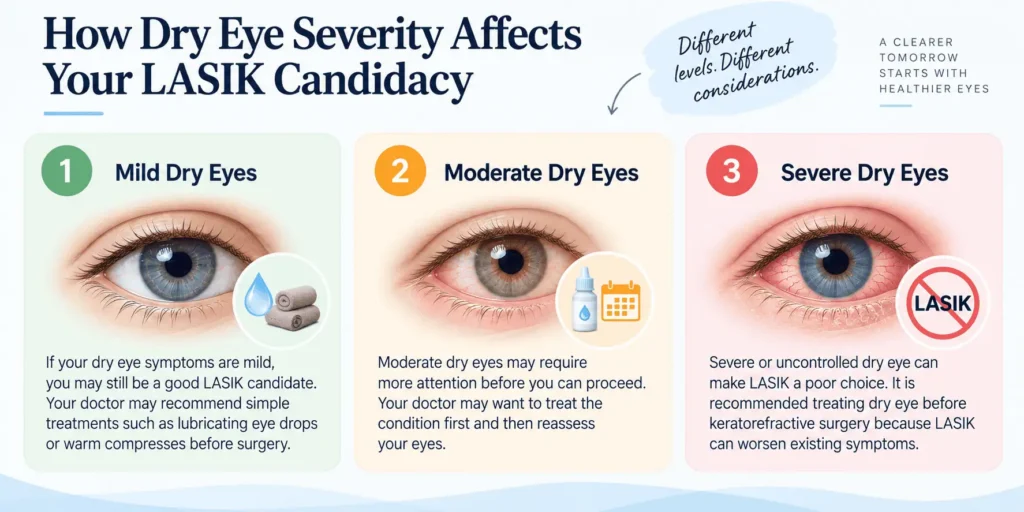
Having dry eyes does not automatically rule out LASIK. What matters is how mild or severe the condition is and whether your eyes are healthy enough for surgery.
1. Mild Dry Eyes
If your dry eye symptoms are mild, you may still be a good LASIK candidate. Your doctor may recommend simple treatments such as lubricating eye drops or warm compresses before surgery.
The important part is getting your eyes into a stable condition first. Even mild dryness needs to be considered because LASIK can temporarily affect the nerves involved in tear production.
2. Moderate Dry Eyes
Moderate dry eyes may require more attention before you can proceed. Your doctor may want to treat the condition first and then reassess your eyes.
This could mean using artificial tears, improving eyelid hygiene or using prescription anti-inflammatory medication if appropriate. In some cases, surgery may be delayed until the surface of the eye is healthier.
3. Severe Dry Eyes
Severe or uncontrolled dry eye can make LASIK a poor choice. The American Academy of Ophthalmology recommends treating dry eye before keratorefractive surgery because LASIK can worsen existing symptoms. In some cases, surgery may need to be postponed or another procedure may be considered.
Learn more about: Dry Eye Syndrome: Everything You Need to Know About
Why Does Pre-Existing Dry Eye Matter for LASIK?
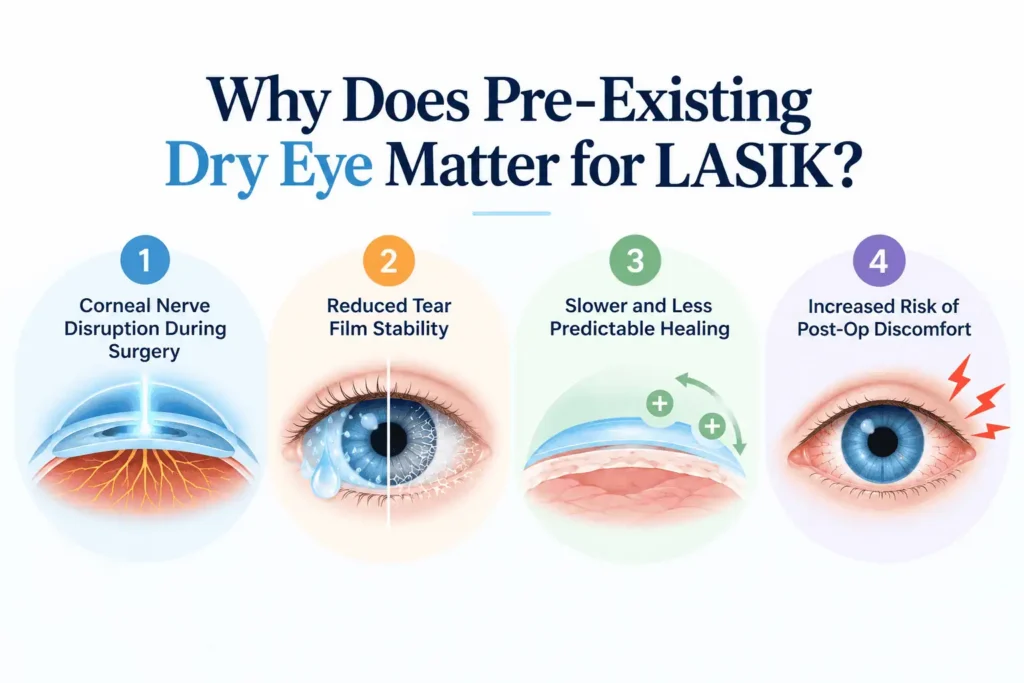
Dry eye matters because LASIK temporarily affects the corneal nerves and the surface of the eye. If your eyes are already struggling to maintain a healthy tear film, the procedure may make those symptoms more noticeable during recovery.
Here are a few reasons your doctor will take dry eye seriously before LASIK.
1. Corneal Nerve Disruption During Surgery
LASIK involves creating a corneal flap and reshaping the cornea with a laser. Some of the nerves in the cornea are affected during this process.
These nerves play a role in normal tear production and sensation. As the nerves recover, some people may experience temporary dryness or changes in how their eyes feel.
2. Reduced Tear Film Stability
Your eyes need a stable layer of tears across the cornea to stay comfortable and maintain clear vision. If that tear film breaks up too quickly, you may experience burning, irritation, fluctuating vision or a gritty feeling.
Existing dry eyes can make this more of a concern after surgery.
3. Slower and Less Predictable Healing
A healthy ocular surface gives the eye a better environment for recovery. If the surface is already irritated or inflamed, your doctor may want to address that first rather than moving straight to surgery.
4. Increased Risk of Post-Op Discomfort
Dryness is already a possible side effect after LASIK. If you have dry eye before surgery, you may have a higher chance of experiencing uncomfortable symptoms during recovery.
That is why treating dry eyes before LASIK is not simply an extra step. It is part of deciding whether the procedure is appropriate for you.
How Does a Doctor Diagnose Dry Eyes Before LASIK?
Your doctor will usually look at more than whether your eyes feel dry. A proper pre-LASIK evaluation can include several tests and observations.
1. Schirmer Test
This test uses a small strip of paper to measure how much your eyes produce tears over a set period.
2. Tear Breakup Time
Your doctor can check how long your tear film stays stable after blinking. A shorter breakup time can indicate an unstable tear film.
3. Imaging
Corneal and tear-film imaging can help doctors examine the surface of the eye. Depending on the evaluation, imaging may also be used to look at the meibomian glands and other structures associated with dry eye.
4. Tear Osmolarity
A tear osmolarity test measures the concentration of substances in your tears. It can provide additional information about the condition of the tear film.
5. Eyelid Condition
Your eyelids and the glands around them also matter. Problems with the eyelids or oil-producing glands can affect the quality of your tears.
6. Environmental Triggers
Your doctor may also ask about things that could be making your symptoms worse, such as prolonged screen use, air conditioning, wind, smoke or contact lens use.
Looking at these factors together gives your doctor a better idea of what is causing the dryness and whether it needs treatment before LASIK.
Treatment Options for Dry Eyes Before LASIK
If dry eye is found during your evaluation, your doctor may recommend treatment before considering surgery. Depending on the cause and severity, this can include:
1. Regular Lubricating Drops
Artificial tears can help add moisture to the surface of the eye and improve comfort.
2. Warm Compresses
Warm compresses may help improve oil flow from the glands along the eyelids, particularly when those glands are contributing to dry eye.
3. Omega-3 Supplements
Some people use omega-3 supplements for dry eye, although the evidence for their benefit is mixed. If you are considering them, ask your eye doctor whether they make sense for you.
4. Eyelid Hygiene
Keeping the eyelids and lashes clean can help manage certain causes of ocular surface irritation.
5. Anti-Inflammatory Eye Drops
If inflammation is contributing to dry eye, your doctor may prescribe medication to bring it under control. These should only be used according to your eye doctor’s instructions.
LASIK Alternatives for Dry Eye Patients
If LASIK is not the right fit, you may still have other vision correction options. The appropriate choice depends on your prescription, corneal health, age and overall eye condition.
1. RLE: Refractive lens exchange replaces the natural lens of the eye with an artificial intraocular lens. It may be considered for some patients, particularly when age-related vision changes are also a concern.
2. SMILE: SMILE is a flapless laser procedure that uses a small incision to reshape the cornea. It may be an option for some patients and can have a different dry eye profile from LASIK.
3. PRK: PRK reshapes the cornea without creating a LASIK flap. It may be considered for certain patients who are not ideal LASIK candidates.
4. ICL: An implantable collamer lens is placed inside the eye rather than reshaping the cornea. It can be an option for some people with certain prescriptions or corneal considerations.
These procedures are not automatically better for someone with dry eye. Your doctor needs to determine which option makes sense for your particular eyes.
Get a LASIK Evaluation at InSight Vision Center, Fresno, CA
If you’re considering LASIK and have dry eyes, the first step is a proper eye evaluation. At InSight Vision Center in Fresno, your consultation includes a detailed check of your vision, eye health, prescription, and tear production. This helps our team assess your dry eye risk and determine whether LASIK is a suitable option for you.
We offer 100% free LASIK consultations with no obligation. The consultation takes about an hour and gives you a chance to understand your options and discuss whether LASIK is right for your eyes.
Find out if LASIK is right for your dry eyes?
Schedule a FREE LASIK consultation with our eye care specialists today.

Dr. Azhar I. Salahuddin is an ophthalmologist and is fellowship-trained in cornea, external diseases, and refractive surgery. Dr. Salahuddin has been performing cataract surgery for over 19 years and specializes ocular reconstruction, corneal transplantation surgery as well as vision correction through a variety of intraocular lenses. Dr. Salahuddin is board-certified by the American Board of Ophthalmology and was trained at Boston University.