
15 Astigmatism Facts You Need to Know
Most people have some degree of astigmatism yet it remains one of the most misunderstood eye conditions. You may be squinting at this screen right now because of it. From what actually causes it to how modern treatments can permanently correct it, here are 15 facts your eye doctor wants you to know.
What Is Astigmatism?
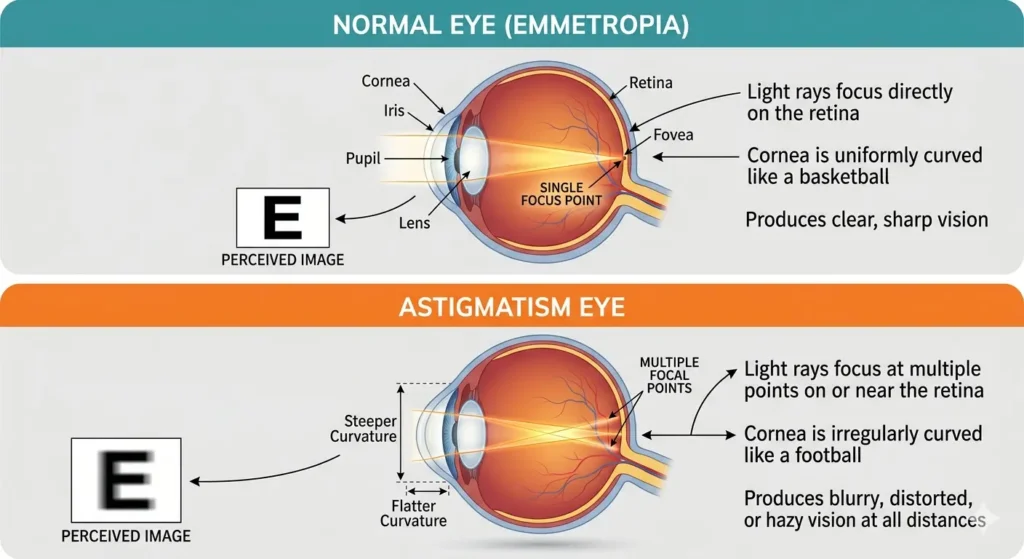
Astigmatism is a common refractive error caused by an irregularly shaped cornea or lens. Instead of being perfectly round, the eye is shaped more like a football – causing light to focus unevenly on the retina and leading to blurred or distorted vision at all distances.
Read our complete guide: What Is Astigmatism? Causes, Types, Symptoms & Treatment
Astigmatism Facts Most People Don’t Know About
Fact 1: Your corneas are Irregularly-shaped
📌 Quick Answer
Astigmatism is caused by an irregularly shaped cornea or lens that prevents light from focusing evenly on the retina, resulting in blurred or distorted vision.
A healthy cornea is uniformly curved — like a perfectly round ball. In a person with astigmatism, the cornea (or the eye’s lens) has an oblong shape, more like a football. This irregular curve means that light entering the eye is refracted at different angles and lands on multiple focal points on the retina rather than one precise point.
The result? Images appear blurry, stretched, or tilted — both up close and at a distance. Unlike conditions such as glaucoma or macular degeneration, astigmatism is not caused by damage to the eye. It is a structural variation in the shape of the eye itself, which is why it is classified as a refractive error.
📊 Key Statistic: Astigmatism affects approximately 1 in 3 people globally, making it one of the most common vision conditions in the world.Fact 2: Astigmatism Is Largely Genetic
📌 Quick Answer
If one or both of your parents have astigmatism, your risk of developing it is significantly higher.
An irregularly shaped cornea is a genetic trait passed down through families – much like eye colour or height. Research has identified multiple gene variants associated with corneal shape, which explains why astigmatism often runs across generations.
This does not mean you are helpless. Even if astigmatism is in your genes, regular eye exams allow it to be detected and corrected early — before it affects your quality of life or, in children, academic performance. If astigmatism runs in your family, annual comprehensive eye exams are especially important.
Fact 3: Children Can Have Astigmatism From Birth
📌 Quick Answer
Astigmatism is one of the most common vision problems in children and is often present from birth. Early detection is critical to prevent long-term complications.
Children cannot always describe blurry or distorted vision – especially if they have never experienced clear vision and do not know what they are missing. This is what makes pediatric astigmatism so easy to overlook.
If left uncorrected in children, astigmatism can lead to:
- Amblyopia (Lazy Eye): The brain suppresses the blurry image from the weaker eye.
- Learning difficulties: Difficulty reading or focusing.
- Frequent headaches and eye strain
Fact 4: Astigmatism Impairs Your Depth Perception
📌 Quick Answer
Astigmatism can make it harder to accurately judge distance.
Accurate depth perception requires both eyes to work together. Astigmatism disrupts this coordination.
Fact 5: Astigmatism Has More Than One Type
📌 Quick Answer
There are multiple structural and classification types of astigmatism.
By Structure
- Corneal Astigmatism
- Lenticular Astigmatism
By Classification
- Regular Astigmatism
- Irregular Astigmatism
Fact 6: Astigmatism Is Measured in Dioptres
📌 Quick Answer
Higher dioptre = greater severity.
| Severity | Dioptre Range | Experience |
|---|---|---|
| Mild | <1.00 D | Slight blur |
| Moderate | 1–2 D | Eyestrain |
| Severe | 2–3 D | Distortion |
| Extreme | >3 D | Impairment |
Fact 7: Astigmatism Is Not a Disease
📌 Quick Answer
Astigmatism is a refractive error – a variation in the physical shape of the eye and not a disease, infection, or sign of a deteriorating eye.
This distinction matters because many people are unnecessarily anxious when first diagnosed. Regular astigmatism is a structural characteristic of your eye, similar to having flat feet — it is something to be corrected, not treated as a medical emergency.
However, irregular astigmatism is a different matter. When the cornea has an unpredictable, asymmetrical curvature, it may signal underlying conditions such as keratoconus (progressive corneal thinning), corneal scarring, or post-surgical changes. If your eye doctor identifies irregular astigmatism, further evaluation is warranted.
Fact 8: Astigmatism Can Get Worse Over Time
📌 Quick Answer
Astigmatism can change and increase over time — though in regular astigmatism it does not damage the eye or cause blindness simply by progressing.
Vision changes are common in childhood and early adulthood as the eyes develop. In adults, astigmatism tends to be more stable but can shift gradually. Conditions that may cause astigmatism to worsen include keratoconus, eye injuries or surgery, and excessive eye rubbing.
Annual eye exams ensure your prescription stays current and vision remains comfortably corrected — even as the numbers change.
Fact 9: Vigorous Eye Rubbing Can Damage Your Cornea
📌 Quick Answer
Chronic and vigorous eye rubbing is strongly linked to worsening astigmatism — particularly in people with or at risk of keratoconus.
When you rub your eyes repeatedly with force, you increase mechanical pressure on the cornea. In individuals with a structurally weakened cornea — as in keratoconus — this pressure can accelerate corneal thinning and distortion, worsening astigmatism progressively.
Allergies are the most common cause of habitual eye rubbing. Treating the underlying allergy protects your corneal health. Even for regular astigmatism patients, eye rubbing is a habit worth breaking — it also introduces bacteria from hands to eyes and risks scratching the corneal surface.
Fact 10: High Blood Sugar Can Alter Your Lens Shape
📌 Quick Answer
High blood sugar levels can temporarily change the shape of the eye’s lens, affecting how light is focused and potentially influencing astigmatic measurements.
Blood glucose fluctuations cause the lens to absorb or release fluid, changing its curvature. A person with poorly controlled blood sugar may experience shifting vision — sometimes appearing as changed astigmatism — that stabilises once blood sugar is better managed.
Beyond astigmatism, diabetic eye disease collectively refers to a group of conditions including diabetic retinopathy, diabetic macular edema, cataracts, and glaucoma. If you have diabetes, regular eye exams are essential.
📌 Clinical NoteIf you are a diabetic patient and your prescription seems to keep changing, have your blood sugar stabilised before getting new glasses or contact lenses. A prescription measured during blood sugar fluctuation may not reflect your stable vision.
Fact 11: Reading in the Dark Does Not Cause Astigmatism
📌 Quick Answer
Reading in dim light, sitting close to screens, or similar habits do not cause astigmatism. This is a common myth.
Astigmatism is a structural characteristic of the cornea or lens — something you are largely born with or develop over time due to hereditary factors. Low-light reading does not reshape the cornea.
What reading in the dark can cause is eye strain, headaches, and temporary visual fatigue — symptoms that may feel like worsening vision but resolve with rest. What actually can affect astigmatism over time includes keratoconus, eye injuries, chronic vigorous eye rubbing, and certain eye surgeries.
Fact 12: Astigmatism Makes Night Driving More Dangerous
📌 Quick Answer
Astigmatism significantly worsens night vision — causing halos, starbursts, and glare around lights that can impair safe driving when left uncorrected.
In daylight, your pupils are small, limiting the amount of light that enters and compensating somewhat for an irregular cornea. At night, pupils dilate widely — which means more of the irregularly shaped cornea is in use, and optical imperfections have a greater effect on vision.
The result: oncoming headlights may appear to streak, street lights may look surrounded by halos, and it becomes harder to read signs or judge distances. Ensuring your prescription is current, using anti-reflective coated lenses, and discussing surgical options with your ophthalmologist can all help.
Fact 13: Astigmatism Is Not the Same as Nearsightedness
📌 Quick Answer
Astigmatism, nearsightedness, and farsightedness are all refractive errors — but they arise from different structural variations in the eye and affect vision differently.
| Condition | Cause | Vision Effect |
|---|---|---|
| Astigmatism | Irregularly shaped cornea or lens | Blurry or distorted at ALL distances |
| Nearsightedness (Myopia) | Eye is too long front-to-back | Clear up close; blurry far away |
| Farsightedness (Hyperopia) | Eye is too short front-to-back | Often blurry up close; may be clear far away |
| Presbyopia | Age-related stiffening of the lens | Difficulty focusing up close (40+ years) |
Many people with astigmatism are also nearsighted (myopic astigmatism) or farsighted (hyperopic astigmatism). Your full prescription accounts for all of these corrections simultaneously.
Fact 14: Screen Time Amplifies Astigmatism Symptoms
📌 Quick Answer
Screen time does not directly cause or worsen astigmatism, but it significantly amplifies its symptoms — particularly eye strain, headaches, and blurred vision.
With the average American spending 7+ hours per day on screens, digital eye strain has become a leading complaint in eye care. For someone with uncorrected or undercorrected astigmatism, screen use is noticeably more uncomfortable because the eyes constantly struggle to bring an imperfect image into focus.
What you can do:
- Follow the 20-20-20 rule: Every 20 minutes, look at something 20 feet away for at least 20 seconds.
- Keep your prescription current and ensure it specifically corrects astigmatism.
- Increase screen font size and contrast to reduce visual effort.
- Consider anti-reflective lenses designed for screen use.
Fact 15: Astigmatism Has Multiple Permanent Treatment Options
📌 Quick Answer
Astigmatism can be corrected with glasses, toric contact lenses, or permanent surgical options including LASIK, PRK, ICL, and Toric IOLs — depending on your severity, eye health, and lifestyle.
1. Eyeglasses: The simplest and most common correction.
2. Toric Contact Lenses: Specially designed lenses for astigmatism.
3. LASIK Surgery: Lasik reshapes the cornea for clear vision. Read More.
4. PRK: Alternative to LASIK for thinner corneas.
5. ICL: Implanted lens for non-LASIK candidates.
6. Toric IOLs: Used during cataract surgery.
7. Corneal Cross-Linking: Stops keratoconus progression.
Struggling with blurry or distorted vision?
Get a comprehensive eye evaluation and personalized treatment plan from our specialists.
This article is general information and isn't a substitute for an eye exam.